




By Karen LeBlanc
“Reported on location in Scottsdale, Arizona. All photography by the author.”

Table of Contents
- A Scottsdale art gallery inside a 1950s church
- The dealers who aren’t artists
- What happens when a collector lets go
- Gallery or auction? The 93% question
- Auction day: 400 works, one room, six hours
- Fritz Scholder and the Arizona artists worth knowing
- Cattle Track, the Phoenix Art Museum, and how a market gets built
- The sculpture garden, and what it taught me
- Plan your visit to Larsen Gallery
- Frequently asked questions
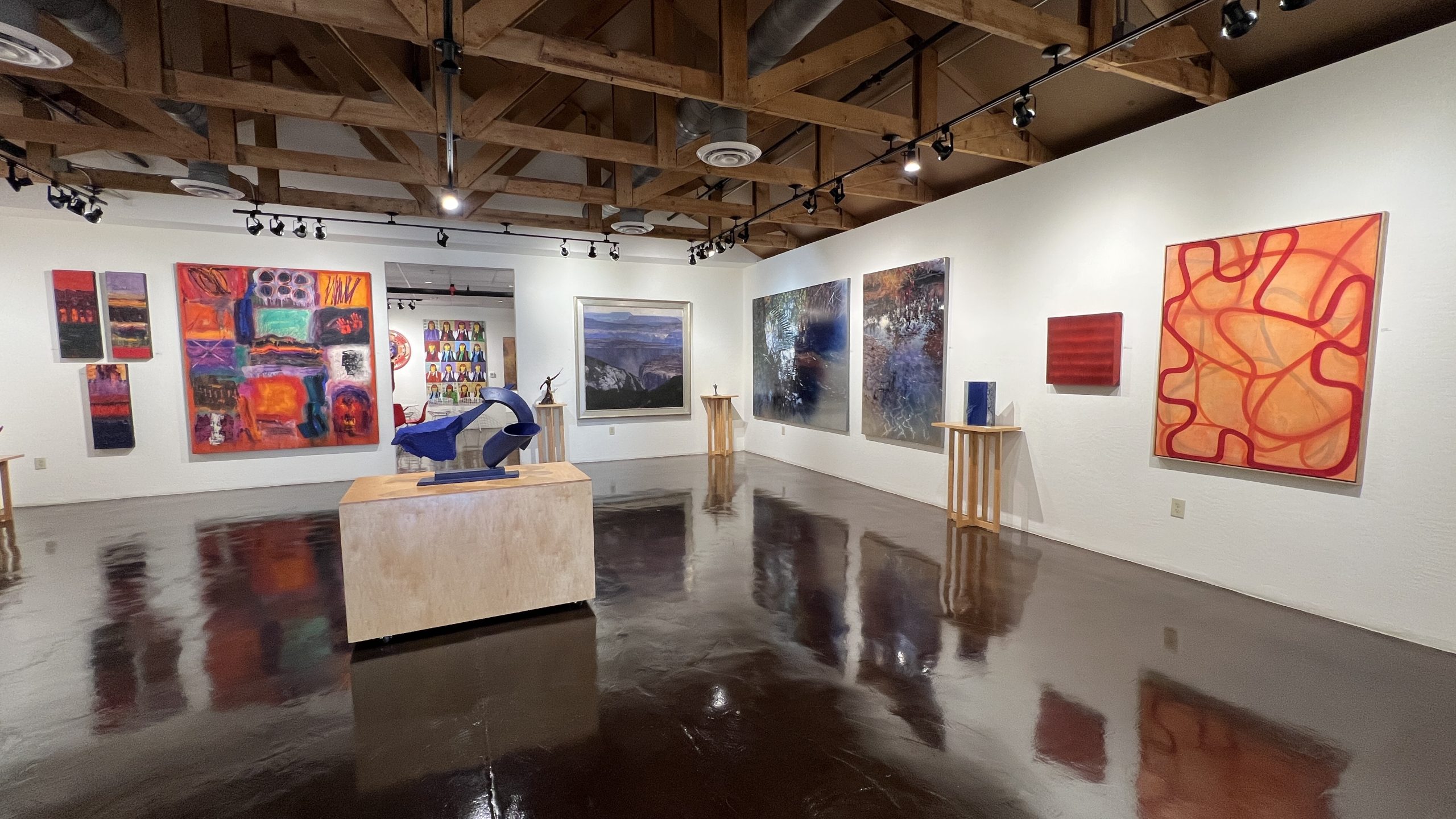
Inside Larsen Gallery in Scottsdale, art does not sit still for long.

Paintings arrive from private homes. Sculptures wait in the garden for the next auction. Works by Picasso and Andy Warhol share a room with artists whose visual language was shaped entirely by Arizona. Nearly every piece has already lived somewhere else, and nearly every one is waiting for its next chapter.
That sense of movement is what struck me as I walked the gallery with owner Scott Larsen, voice recorder in hand. I had come to explore Scottsdale’s art scene and expected the usual: artists, exhibitions, a roster of represented names. What I found instead was a business built around the afterlife of a collection — what happens to art when a collector downsizes, an estate changes hands, or a family finally decides it is time to let a beloved painting go.
At Larsen Gallery, those private turning points become part of a much larger cultural exchange. And for a traveler, that means something unusual: no two visits are ever quite the same.
If the relationship between art and the built environment interests you, it runs all through this region — you can explore it further in my guide to Arizona’s must-see architectural attractions.
A Scottsdale art gallery inside a 1950s church

The 5,400-square-foot gallery occupies a former church built in the mid-1950s. Scott and his wife, Polly Larsen, bought the building in 2004 and kept the original rafters overhead, so the main room still reads as a sanctuary — a long, light-filled space that runs clear to the back. A church that becomes a gallery is adaptive reuse at its most literal, and the impulse behind it is one I keep running into — what it really takes to preserve a historic building beyond its facade.
“It’s kind of a unique experience,” Scott told me as we started walking.

The couple has run the business for more than 30 years, after purchasing the assets of the C.G. Rein Gallery in the 1990s. They divided the work according to what each of them brought: Polly has the deeper art background, Scott the business one.
“There was an opportunity to buy one of the larger galleries in town, so we did that,” he said. “And then it’s just kind of evolved since then.”
The dealers who aren’t artists — how Larsen Gallery works
Somewhere in the first few minutes, I asked whether either of them paints.
“No,” Scott said. “We’re just dealers.”
I liked the flatness of that answer. There is a romantic version of the gallery story in which the owners are frustrated artists living vicariously through the work on their walls. This is not that. The Larsens are in the business of moving art between people who own it and people who want it — and that clarity turns out to shape everything about how the gallery operates.
Unlike most Scottsdale art galleries, Larsen Gallery does not represent living artists or organize its inventory around a stable roster. It specializes in fine art consigned by private owners looking to resell. Contemporary work, Southwest and Western art, sculpture, prints, paintings, ceramics and glass can all arrive on the same afternoon.
“We get new work in every day,” Scott said, “both for the gallery and for the auction.”
What happens when a collector lets go
As we moved from wall to wall, Scott explained how a consignment usually begins — and it is almost always a life transition.
A collector is moving into a smaller house or a retirement community and no longer has the wall space. An estate holds more art than the next generation wants to keep. Someone is simply ready to sell what they bought at 40 and buy something that reflects who they are at 70.
“We’ll evaluate their artwork to see if it’s more conducive for them to consign it to the gallery, or something that might be more conducive to them for the auction,” he said. “So it gives the client kind of a different option.”
There is something deeply human in that process, and it reframed the room for me. We tend to think of collecting as acquisition — the thrill of finding, buying, bringing home. What I was watching at Larsen Gallery was the other half of stewardship: the moment someone decides where a piece goes next.
These works are commodities, certainly. They are also carriers of memory, taste and identity. A painting holds the story of the person who chose it, the room where it hung, the argument about where to hang it. Resale doesn’t erase any of that. It layers on another chapter. I encountered that same bond between artwork, collector and place while tracing the cultural legacy of Louisiana painter George Rodrigue in Why Is the Blue Dog Blue?
Gallery or auction? The 93% question every consignor asks

I wanted to know how they decide which route a work takes. The answer is one of the most useful things I learned all day, and it applies to anyone who has ever wondered what to do with inherited art.
“Typically the gallery pricing is higher, but our commission percentage that we take is also higher,” Scott said. “And there’s no way to determine how long it will take to sell.”
The auction is the other path — faster, with a deadline attached.
“At the auction, we sell 93% of the works consistently,” he said. “So if a person is just looking to move off their artwork and not have to worry about it being on consignment for six months or something like that, then they can consign it into the auction, and odds are it’ll sell.”
That number is the whole business model in miniature. The gallery offers a higher ceiling and an open-ended wait. The auction offers near-certainty and a date on the calendar. Which one is right depends entirely on whether the seller needs a price or needs an ending.
Auction day: 400 works, one room, six hours

The consignment business led naturally to the auction business. Larsen Gallery launched the Larsen Art Auction roughly 14 years ago, and now holds two fine art sales a year, in April and October — about 400 works each, all sold in a single day.
Scott described the choreography, and it is considerable. Every lot must be identified, brought in, professionally photographed for the website and the printed catalog, and marketed. A specialist fine art auctioneer comes in from Atlanta. Then the room itself transforms.

“The auction is actually in this room,” he said, gesturing at the display racks lining the gallery. “These all just break down and remove, we move them off site, and then we set up like 150 chairs in here, and the auctioneer is up there.”
Then came the detail that made the whole thing feel less like an intimidating auction-house ritual and more like a Scottsdale party: “And then we serve lunch and have a full bar.”
Sales run from 10 a.m. to about 4 p.m. Registered bidders come from most every U.S. state and more than 40 countries, which means a painting that spent thirty years above a fireplace in Paradise Valley may leave the room bound for another continent.
Flipping through the April catalog, Scott pointed out the range: David Hockney, Patrick Hughes multiples, Chihuly glass, a couple of large ceramic and glass collections that had come in together, mid-century modern furniture, and oversized vintage René Vincent posters. A Luis Jiménez. An Antonio Saura that went well above estimate.
“So as you can see,” he said, “it’s a wide variety.”
Fritz Scholder and the Arizona artists worth knowing

The internationally recognizable names draw attention, but I had come to Scottsdale interested in Arizona artists, and this is where the conversation opened up.
Larsen Gallery has specialized in Fritz Scholder since the 1980s and, by Scott’s account, sells more of his work than any other gallery in the country — more than $10 million worth over the years.
“He’s probably Arizona’s most famous artist,” Scott said.

Scholder, who was part Native American, built his reputation on what Scott called non-traditional Indians — a deliberate break from the romanticized Western imagery that dominated before him. Where earlier painters gave audiences the Indian of the movies, Scholder painted contemporary Native people in contemporary settings. His best-known works include Indian at the Bar, which shows exactly that: a man at a bar with a can of Coors. His output through the 1970s is considered his most collectible.

Scott also walked me past work by Mark McDowell, a longtime local artist who was painting alongside Scholder and is known in part for a series built around circus imagery. And he spoke about Philip C. Curtis, a founder of the Phoenix Art Museum with a distinctive surrealist style, and James G. Davis, a Tucson surrealist no longer living.
Cattle Track, the Phoenix Art Museum, and how a market gets built
Two threads from that conversation stayed with me, and together they explain how a regional art scene actually sustains itself.
The first is Cattle Track, an artist colony in Scottsdale where Scholder, Curtis and a number of other Arizona artists have lived and worked for decades. Scott described it as held in a trust, providing studios and housing that stay affordable while artists are actively working. Mark McDowell now helps oversee it — a working artist stewarding the place that sheltered the generation before him.
The second is the pipeline into public collections. Scott told me the gallery has been instrumental in helping private collectors build significant Scholder holdings, and that more than one of those collections was later donated to a museum. He described another collector, Kent Logan, who had the gallery acquire a series of paintings on his behalf; Logan later donated them and produced a book that traveled to several museums.
“He kind of helped jumpstart his market,” Scott said of one of the artists involved.
That sentence stopped me. It is a plain description of something we rarely see stated so directly: galleries do not only sell objects. They help establish markets, influence what gets collected, and — indirectly, years later — shape what enters the public record.
I was headed to the Phoenix Art Museum that same afternoon, and Scott gave me a thread to follow. There is a large James Davis painting there. Philip Curtis has an entire room. The art I was looking at in a former church on Bishop Lane was not isolated inventory. It belonged to a wider ecosystem of studios, collectors, galleries and museums stretching across Arizona.
The sculpture garden: what’s headed to the next auction

Our visit ended outdoors. Sculptures stood in the Arizona sun, some monumental, most spoken for.
“Most of what’s out here will be in the auction as well,” Scott said.
I found myself looking at them differently than I would have an hour earlier. They were not decorations marking the end of a gallery tour. They were between homes — momentarily gathered in this garden before dispersing again to living rooms and lobbies and, eventually, someone else’s estate.

That may be the best reason for art lovers to put Larsen Gallery on a Scottsdale itinerary. The gallery offers more than a look at what is for sale. It reveals the circulation of art itself: how creative work moves through lives, how private taste becomes public heritage, and how a painting’s meaning expands with every person who chooses to care for it.
In a city full of galleries, Larsen offers a view behind the polished white wall. The story here is not only about who made the art. It is about who lived with it, who preserved it, and who will carry it forward. If following craft and makers through a place is your kind of travel, that’s the whole premise behind my design lover’s guide to Louisiana.
Plan your visit to Larsen Gallery
Address: 3705 N. Bishop Lane, Scottsdale, Arizona 85251 — one block west of Scottsdale Road, just south of Second Street in the fine art district Hours: Tuesday–Saturday, 10 a.m.–5 p.m., or by appointment Admission: Free Parking: Free visitor spaces at The Rack lot, with additional street parking on Bishop Lane and Second Street Good to know: Inventory changes constantly because private consignments arrive year-round. If you saw something online last month, call before you drive over. Auctions: Two per year, April and October, approximately 400 lots each, sold in a single day from about 10 a.m. to 4 p.m. Live, telephone, absentee and online bidding available. Auction day extras: Lunch and a full bar are served during the sale.
Confirm current hours, auction dates and bidding terms on the official Larsen Gallery and Larsen Art Auction websites before visiting.
Frequently Asked Questions About Larsen Gallery
Is Larsen Gallery worth visiting in Scottsdale? Yes — particularly for travelers interested in fine art, Arizona artists, collecting and the secondary art market. Because privately consigned works arrive continuously, the selection changes throughout the year, so each visit offers something different.
Where is Larsen Gallery located? At 3705 N. Bishop Lane in Scottsdale, Arizona, one block west of Scottsdale Road and just south of Second Street in the city’s fine art district.
Is there an admission fee? No. Admission is free. The gallery is open Tuesday through Saturday, 10 a.m. to 5 p.m., and by appointment.
What kind of art does Larsen Gallery sell? Consigned fine art from private collections. The changing inventory spans contemporary, Southwest and Western art, along with paintings, prints, sculpture, ceramics, glass and works by Arizona, American and internationally known artists.
Does Larsen Gallery represent living artists? No, and that is what makes it unusual. Most galleries build a roster of represented artists. Larsen specializes in reselling fine art consigned by private owners, which is why the inventory turns over constantly.
When are the Larsen Art Auctions held? Twice yearly, in April and October. Each sale offers roughly 400 lots in a single day.
Do I have to attend in person to bid? No. Live, telephone, absentee and online bidding are available. Registered bidders come from most U.S. states and more than 40 countries. Check the auction website for registration deadlines.
What percentage of works sell at the Larsen Art Auction? Owner Scott Larsen says the auction consistently sells about 93% of consigned works — which is why sellers who want a defined timeline often choose the auction over an open-ended gallery consignment.
Can I consign artwork through Larsen Gallery? Yes. The gallery evaluates fine art for consignment and helps owners decide whether a gallery listing or the auction better suits the work and their goals. Submit photographs, dimensions and any provenance information through the gallery’s official website.
Which Arizona artists does Larsen Gallery handle? The gallery has specialized in Fritz Scholder since the 1980s and also handles work by Mark McDowell, Philip C. Curtis and James G. Davis, among others — with connections to Scottsdale’s Cattle Track artist colony and the Phoenix Art Museum.
Can I take photos inside the gallery? Scott Larsen raised no objection during my visit, but courtesy still applies — ask at the desk when you arrive, particularly if you plan to publish.