





This post contains affiliate links. If you buy through them, I may earn a small commission at no extra cost to you. I only recommend gear I actually use and love. See my full disclosure here.
I’ve been filming LA 64 long enough now to notice something the guidebooks never mention.
Louisiana doesn’t throw things away.
A jail becomes a tourist attraction. A cattle auction barn becomes a listening room with better acoustics than most concert halls. A high school becomes an antique mall with 200 vendors and the principal’s office sign still on the door. A jewelry store becomes a restaurant, and the vault becomes the wine cellar. Old satellite dishes become garden art. A log that sank to the bottom of a bayou in 1890 becomes a dining table in 2026.
I came to these parishes looking for stories. What I found was a design philosophy — one nobody down here would ever call a design philosophy. They’d just call it not wasting anything.
So here’s my design lover’s guide to Louisiana: not a list of pretty places, but a road map to how this state actually makes things. Follow it by material, by maker, by building. Then go see it for yourself.
Table of Contents
The Materials: Louisiana’s Design DNA

Every design region has a signature material. Japan has cedar and paper. Morocco has zellige. Louisiana has four, and three of them almost disappeared.
Sinker Cypress: The State’s Most Beautiful Mistake
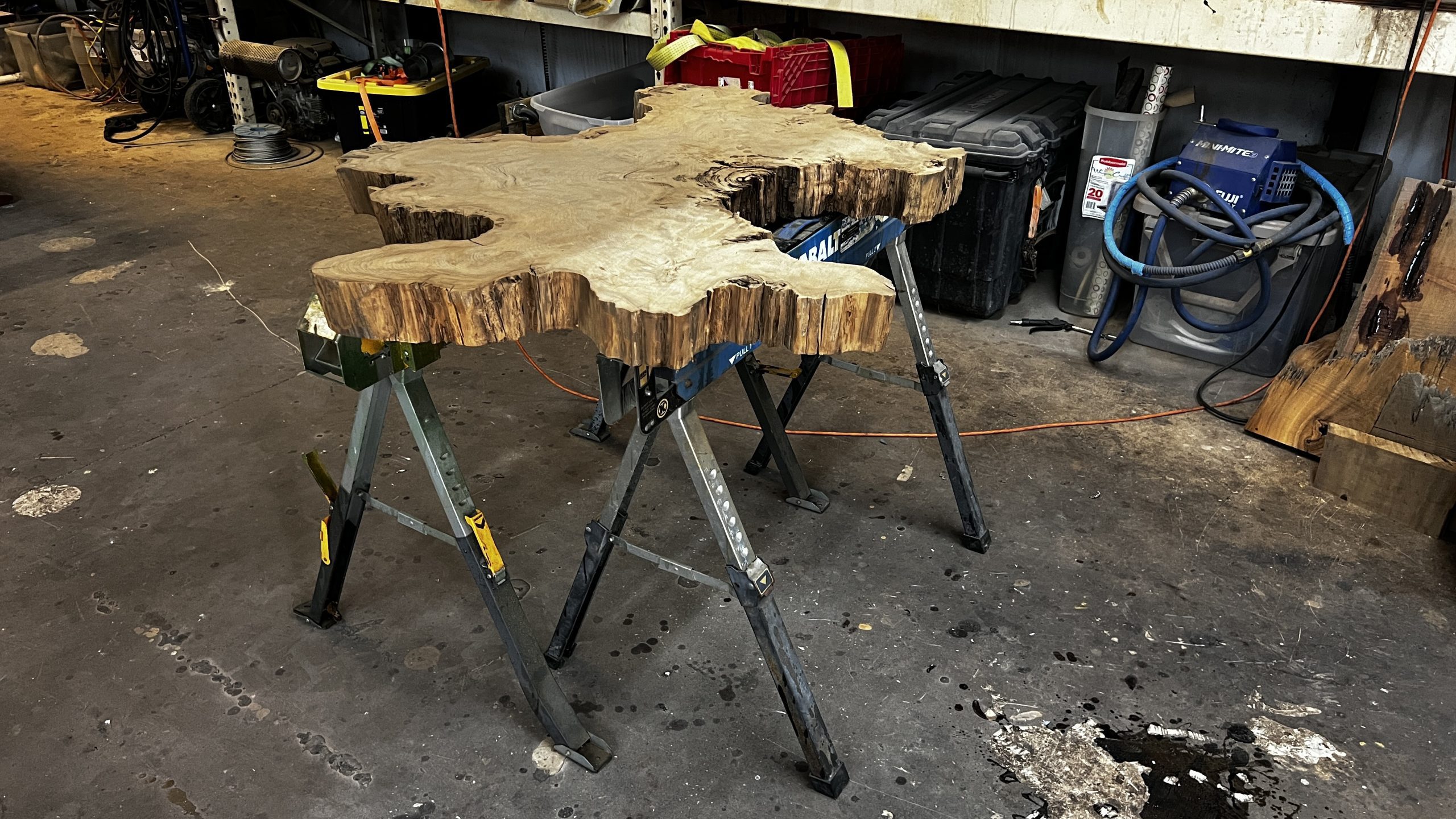
Here’s a fact most people don’t know: lumber was Louisiana’s first industry, long before oil and gas.
In the late 1800s, the piney woods and cypress swamps got cut down almost completely. In Beauregard Parish, they stripped the land so bare it earned a new name — Stump Town. A judge in DeRidder told me the old folks used to say you could stand halfway to the Sabine River and see the courthouse dome, because there was nothing left standing in between.
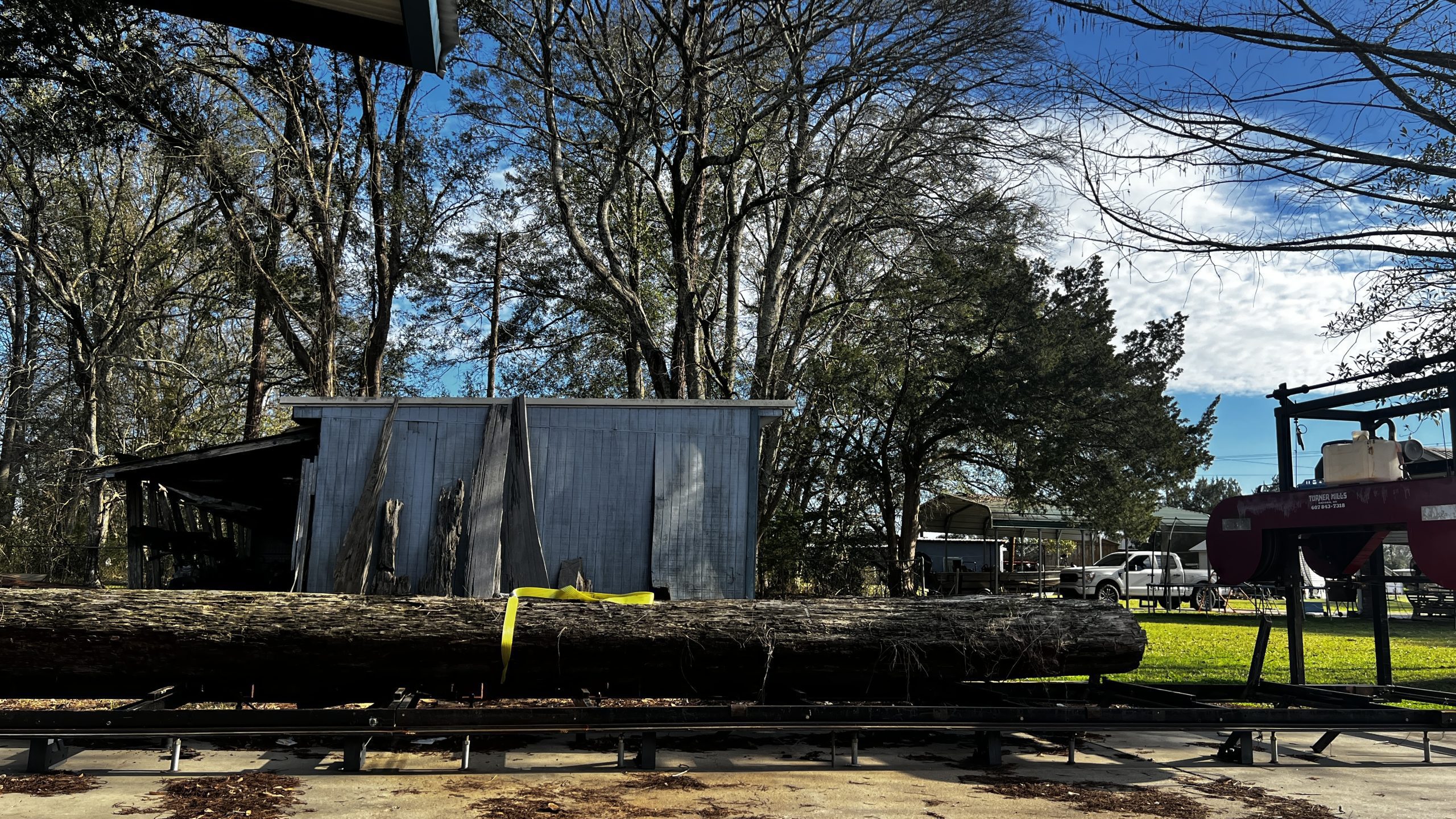
The old-growth cypress logs were floated to the mills. Some of them sank on the way. And that turns out to be the luckiest accident in Louisiana design history.
Those waterlogged giants have been curing at the bottom of logging canals and the Atchafalaya Basin for more than a century. The cypressene oil and the minerals seeped in. Cut one open today and you get greens, blues, blacks — a whole rainbow inside a log that’s been underwater since your great-grandmother was a girl.
Louisiana calls it sinker cypress. It’s both a material and a story, pulled out of the deep water of the past.
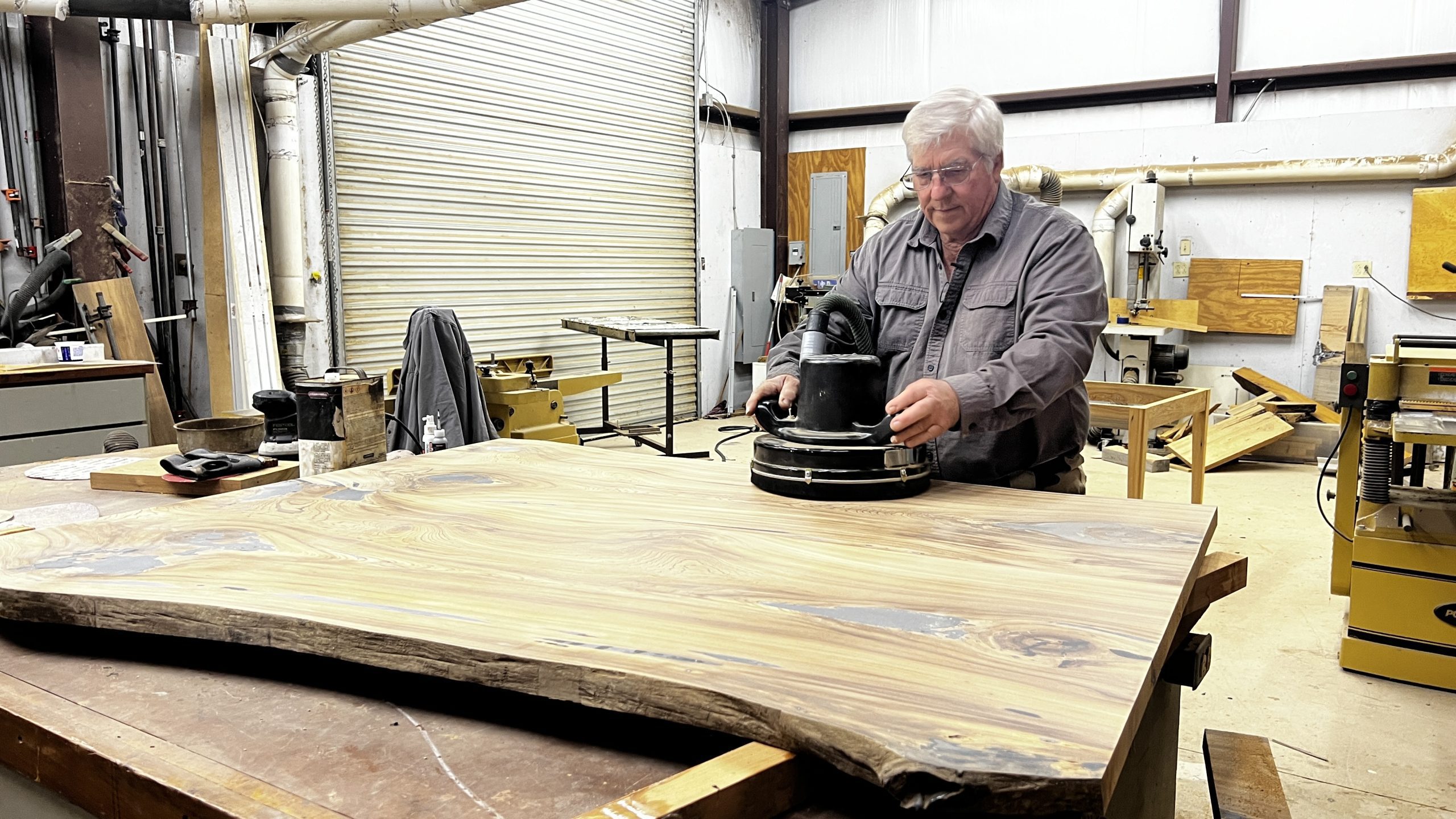
“If I don’t get them out, no one is going to get them out. They’ll be lost forever.” — Eric Couvillion, woodworker
Karen’s tip: Sinker cypress shows up in three different corners of this state doing three different jobs. In Breaux Bridge, Eric Couvillion mills it into furniture. In Franklin, Peter Soprano — 50 years of milling logs, three warehouses full — traces a spoon out of it by hand. In Larose, a fourth-generation boat builder named Ernie Savoie carved a dugout out of a sinker log, restoring a vessel type older than the state itself. Same material. Three centuries of purpose.
Bousillage: Mud, Moss and Handprints
Walk into Louisiana’s oldest surviving buildings and press your hand to the wall. What’s under the plaster is bousillage — clay and Spanish moss, sometimes horsehair, packed between the posts.
It’s the most Louisiana material imaginable. Mud from the bayou. Moss from the oaks. Free, local, and about as low-tech as building gets.

The Roque House is among the oldest surviving examples of Creole architecture in Natchitoches Parish, home of the oldest permanent settlement in the Louisiana Purchase. Natchitoches was founded in 1714. The structure may be the only remaining circa 1790s French Creole post-on-sill house built by a freed man of color. Yves Pacale built the Roque House in Isle Brevelle in 1803, 22 miles down the Cane River Lake on unsurveyed land between two plantations, where it sat for 170 years before moving to the river banks in downtown Natchitoches.

At the Kent House in Alexandria — one of only four surviving examples of its architectural style in the entire state, built in 1800 on a Spanish land grant — you can look closely and spot handprints pressed into the clay. Those hands belonged to enslaved laborers. The house doesn’t look away from that. Neither should we.
The technique turns up again and again once you know to look for it. At Bayou Cabins, the oldest cabin dates to 1848 and the walls hold mud, moss and horsehair.

At St. Martin de Tours, the Grotto of Our Lady of Lourdes is chicken wire stuffed with bousillage — mud and clay from the Bayou Teche — then plastered over. At Maison Madeleine in Breaux Bridge, the 1840s French Creole cottage walls are filled with the same mixture.

You’ve now found bousillage in Rapides (Kent House handprints), St. Martin (Saint Martin de Tours grotto, Maison Madeleine, Bayou Cabins), and Lafourche. Natchitoches has the only two-story example anywhere and the only surviving poteaux-en-terre house (see Segment 3). This parish is the capital of the material.
Four hundred years of Louisiana architecture, and the through-line is dirt.

Go see it:
- Inside Saint Martin de Tours: The Mother Church of the Acadians →
- Inside Maison Madeleine: An 1840s French Creole Cottage Revival →
- Bayou Cabins in Breaux Bridge: A Village of 14 Historic Cajun Homes Restored by Hand →
Coton Jaune: The Seed That Came in a Pocket
I’m a LeBlanc. My ancestors’ names are etched in bronze on the wall at the Acadian Memorial in St. Martinville. So this next material is personal.

When the Acadians were exiled from Nova Scotia and eventually landed in southwest Louisiana, they brought a cotton with them that grows naturally tawny brown. They called it coton jaune. It wasn’t a cash crop. It was a household crop — and the reason why matters enormously to design.

Brown cotton has smooth seeds. You can gin it by hand, at your own kitchen table, with no machine and no mill and no permission from anybody. That single property is why generations of Cajun families could clothe themselves. It’s also why so many historic Cajun garments are khaki-colored. The color wasn’t a style decision. It was the plant.

Here’s the part that stopped me: the seed itself was the heirloom. Mothers and grandmothers passed down carding, spinning and weaving — and they passed down the seed, a family inheritance you could plant.
In St. Martin Parish, fourth-generation cotton planter Jerry Hale got hold of two cups of seed in 2017 because the supply was dwindling down to nothing. Nobody was planting it anymore. He and his wife Mary Alice now have access to close to a thousand heritage patterns. A thousand. That’s not folk craft. That’s a design archive.

Go see it: Cajun Prairie Farm in Arnaudville: Where Cajun Culture Grows →
River Cane: The Craft That Bought Back the Land
The Chitimacha Tribe of Louisiana is the only tribe in the state still living on part of their original homeland. Understanding how they kept it is the single most powerful design story I’ve reported in Louisiana.

River cane is split three times to get a fiber thin enough, durable enough and flexible enough to weave. It’s dyed in four traditional colors — red, black, yellow, green. The baskets are double-woven and watertight, and they follow fifty tribal patterns with names like perch, a little fish. The patterns don’t change. They’re handed down, generation to generation, exactly as received.

When taxes threatened to take the tribe’s remaining land, the women of the tribe wove baskets and sold them through Sarah Avery McIlhenny — heiress to the Tabasco plantation — and the money paid the taxes. The baskets saved the land.

Today there are seven weavers left.
“It’s always that feeling that, you know, it’s you made that and it’s a part of you. But it’s also the same connection with our ancestors that have been making them since the beginning of time.” — John Paul Darden, Chitimacha traditional basket weaver
Go see it: Chitimacha Tribe of Louisiana: How Basket Weaving Saved a Nation in Charenton →
The Culture Keepers: Makers Worth the Drive

I use the phrase culture keeper a lot on this show, and I mean something specific by it. Not a hobbyist. Not a re-enactor. Someone holding a line.
The pattern I keep finding is that these makers are almost never the fourth generation coasting on a tradition. They’re the fourth generation who noticed it was about to stop, and stepped in front of it.
- The rubboard maker. Watch live Zydeco anywhere in the world and there’s a good chance the frottoir on that stage came out of a shop in Sunset, Louisiana. Meet Tee Don Landry: The Rubboard Maker to the Music World →
- The T-fer maker. In Breaux Bridge, welder and musician Brandy Guidry Aubé makes Cajun triangles out of cold-rolled steel. Not decorative ones — instruments. Before amplification, before drums, the T-fer had to ring out over the accordion. She sets her intention on the sound.
- The quilter. Meet Anne Hitt: The Lafourche Parish Quilter Stitching Hope, One Heartfelt Doll at a Time →
- The pop art scientist. Westwego’s murals, painted objects, stenciled stormtroopers and general creative electricity trace back to one gallery on Sala Avenue. Why Joshua Wingerter’s Westwego Gallery Is One of Louisiana’s Most Unexpected Art Stops →
- The accordion maker and the family band. Marc Savoy has been handcrafting Cajun accordions stamped Louisiana Made and hosting Saturday morning jams at his Eunice music store for sixty years and counting. The Savoy Family of Musicians: Louisiana’s Culture Keepers →
- The ambassador. Meet Cajun Culture Keeper Jourdan Thibodeaux →
Karen’s tip: If you want one word to organize a Louisiana craft trip around, make it Certified Louisiana. It’s a state program supporting artisans and growers making things right here. Shopping local isn’t a virtue signal in this state — it’s the only way to get the real thing.
Reading Louisiana Like a Pattern Book

Most travelers experience Louisiana architecture as a single note: the antebellum column. That note is real, but it’s about two percent of the score.
Drive the whole state and you get a pattern book:
The dog trot. A breezeway down the middle, rooms on either side. In Caddo Parish, there’s an 1850 log dog trot cabin built with single-dovetail joinery — no nails, nothing holding it together but its own weight and gravity. In Beauregard Parish, a century-old camp just built a brand-new dog trot cabin, because the form still works.
The shotgun. In DeRidder, a restored shotgun house that once held sawmill workers is now a gathering space on a walking trail. In Gretna, the shotguns and double shotguns are exactly why young professionals are moving back.
The Creole raised cottage. Kent House, 1800. Maison Madeleine, 1840s. The E.D. White house, built 1825 in Acadian Creole style — spacious, breathable, functional — until a widow redid it in Greek Revival in the late 1840s for the symmetry and the square footage. That renovation is the story of Louisiana taste in one building.
Gothic Revival, in a matched pair. DeRidder’s courthouse and jail went up together in 1914 in the same style. One became a symbol of civic pride the citizens voted to restore. The other became known as the Hanging Jail. Elegant architecture, grim interior — I felt that contrast the second I walked in. DeRidder Gothic Jail: Where Elegant Architecture Meets a Grim and Ghostly History →

Movie palace baroque. That’s the actual term, and Shreveport’s Strand Theatre is a 1500-seat example — the Grand Dame, sister to New Orleans’ Saenger, built by the sons of a local rabbi who went on to open 360 theaters across the South, Cuba and Puerto Rico. A few blocks away, the 3,000-seat Municipal Auditorium is a National Historic Landmark where Elvis debuted in 1954. Shreveport Municipal Auditorium: The Stage Where Country Legends Were Born →
Beaux Arts Neoclassical, in a lumber town. A lumber baron built the Hotel Bentley in Alexandria in 1907 with a marble staircase, an ornamental dome and 10,000 square feet of five-color mosaic floor. Somewhere in that floor is a single blue tile the size of a quarter. Nobody will tell you where. Stepping Into History at Hotel Bentley: Eisenhower, Patton, and the Louisiana Maneuvers →
The Sears kit town. In Grand Cane, the houses are all pushing 100 years old and all built from close to the same Sears and Roebuck plan. Same rooflines. Same porch pillars. Different houses. Louisiana’s own quiet modular experiment.
The schoolhouse a community built by hand. Of nearly 400 Rosenwald Schools constructed in Louisiana during the Jim Crow era, only 20 original buildings remain. One of them is in Longstreet, and the people who learned in it are still telling you what it meant. Longstreet Rosenwald School: The Schoolhouse a Community Built by Hand →
Karen’s tip: Thibodaux prints a self-guided architecture walking tour map — Queen Anne, Greek Revival, Bungalow, Beaux Arts, all in a few walkable blocks. Free, and better than most paid tours I’ve taken abroad.
The New Deal Built Louisiana’s Design Canon
This is the thread I didn’t expect, and it’s the one I’d argue hardest for.
In the 1930s, federal art programs put artists and craftsmen to work across Louisiana, and the result is a body of public design work most people walk past without a glance.

Conrad Albrizio, an LSU professor, painted more than forty murals around the state. His very first fresco is in the entrance of the old DeRidder post office — a rural free mail delivery scene. He was paid $550 for it. He did not get rich. He also did the entrance murals at the Louisiana State Exhibit Museum in Shreveport, a mathematically circular limestone building carved to curve, which opened in 1939 as a New Deal project and holds one of the largest diorama collections in the country. The state wanted to show off its industries without rebuilding fair exhibits every year — so the WPA hired artists to recreate Louisiana in miniature, permanently.
Up in Winnsboro, the 1936 post office has its own New Deal mural: a logging scene, because of course it does.
Down at Longleaf, the Civilian Conservation Corps cabins still stand.
Same decade. Same federal impulse. Four parishes. One almost entirely unwritten design story about who paid for Louisiana’s public art and why.
Second Acts: Adaptive Reuse Is the Local Vernacular
If you take one design idea away from this guide, take this one: Louisiana’s default move is reuse.
I don’t think it started as taste. It started as thrift. But do it for a century and it becomes a look.
- A cattle auction barn. Wooden bleachers built on top of the livestock ring, pitch-perfect acoustics from the barn structure, Grammy winners autographing the walls. The owners put it on the historical registry in 1996 because they could see these buildings vanishing. Richard Sale Barn in Abbeville: A Cattle Auction House Turned Cajun Listening Room →
- A fleet of dead railcars. A blue mail car, a caboose, a ticket booth and a depot, gutted and revived across from a convent campus in Grand Coteau. Sleep in a Real Railcar at Louisiana’s Train Wreck Inn →
- An 1870s mercantile. An architect researched the building down to the Prussian Jewish merchants who built it and the three daughters who ran the store into the 1960s, then turned it into nine hotel rooms. Hotel Klaus: A Historic Boutique Stay in Washington, LA →
- An entire village. Grand Cane’s town government owns every historic building on the street, rents them to businesses, and reinvests the sales tax into buying the next one. It took twenty years. The mayor who drove it is 88. Grand Cane, Louisiana: The Little Village That Saved Its Own Main Street →
And the honorable mentions I couldn’t fit: an oil rig you can walk aboard, a former movie theater full of cowboy boots, a sawmill commissary full of flea market booths, a 1931 jewelry store where the vault is now the wine cellar, a 1910 bank that’s become a folklife museum, a 1912 wholesale grocery warehouse that’s now a national park cultural center, and a retired sign painter in a Beauregard Parish backyard who rescues discarded satellite dishes, preps them, and paints them in weather-resistant enamel because he likes the shape and the movement.
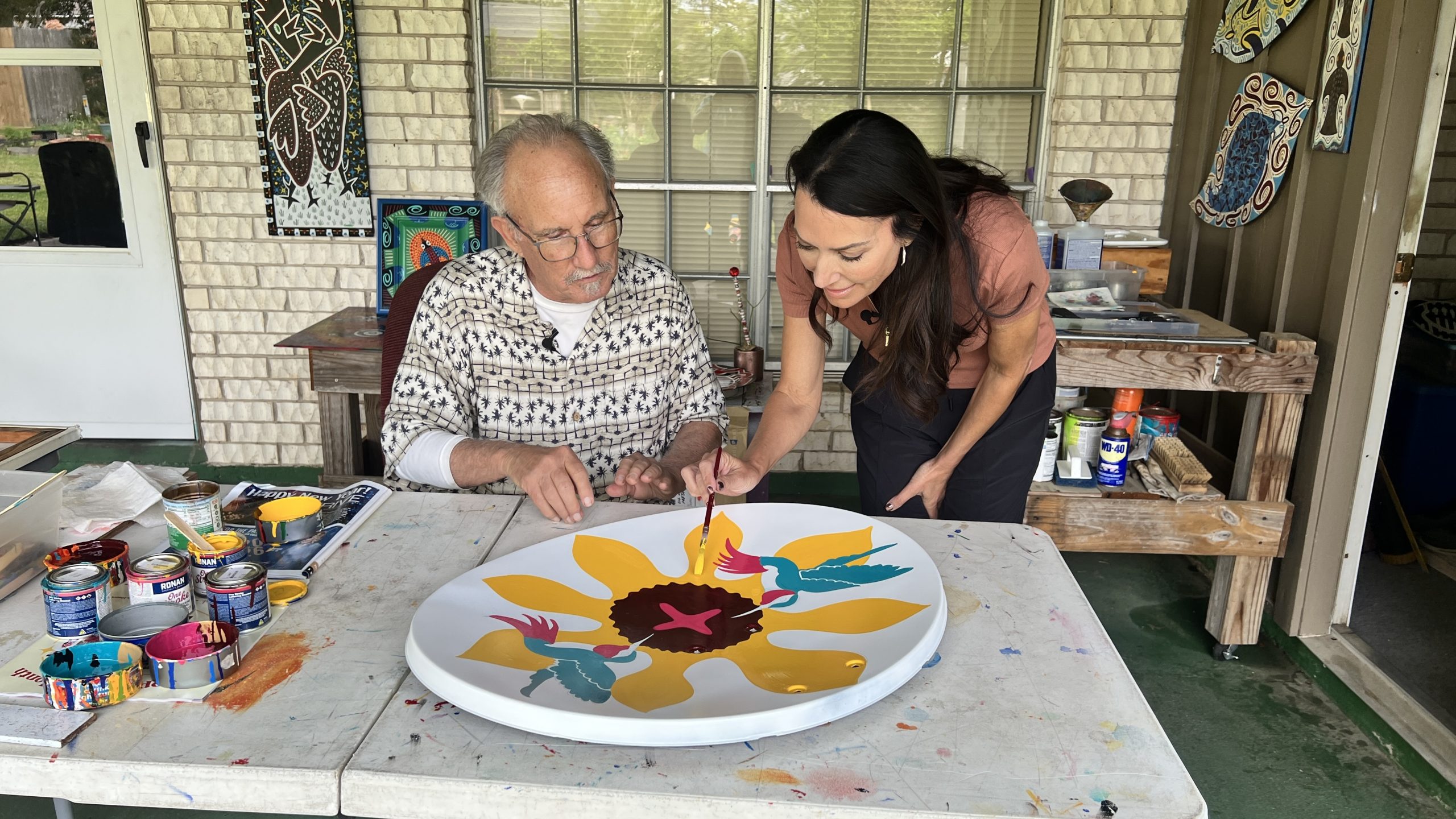
“There’s something poetic about it. Satellite dishes, once built to receive signals from afar, now send out something more human — emotion.”
The General Store: Louisiana’s Original Design Object
The general store deserves its own heading, because in Louisiana it isn’t nostalgia — it’s infrastructure that hasn’t quit.
Donnell’s in Swampers has been in the same building since 1946, with the original paint still on the ceiling where the founder’s grandfather put it. Three siblings keep it open. Not because the numbers work. Because, as Dewey Donnell told me, it’s part of them, and it’s part of the community, and they all just hate to see it go.
In Kaplan, Suire’s spray-paints the menu straight onto the facade. When the menu is painted on the building, you know you’ve found the real thing.
- The Best General Stores in Louisiana Still Worth a Stop →
- Donnell’s General Store: A 1934 Louisiana Country Store →
- Suire’s Grocery and Restaurant: From Country Store to Community Table →
- Three Generations, One Seafood Market: The Temento Family Keeps Westwego Shrimp Lot Alive →

Creative Stays: Sleep Inside the Story
When I travel, I look for accommodations that connect me with the local landscape and the people. In Louisiana, that’s not a luxury category — it’s a preservation strategy. Half the historic buildings still standing in this state are standing because somebody turned them into a place to sleep.
Historic homes restored by hand
- Inside Maison Madeleine: An 1840s French Creole Cottage Revival in Breaux Bridge →
- Bayou Cabins in Breaux Bridge: A Village of 14 Historic Cajun Homes Restored by Hand →
- Staying At Maison Stephanie In Arnaudville, Where Louisiana’s Past Lives On →
- The Dover House in Florien: A Living Museum Airbnb →
- Inside the Caldwell House: Abbeville’s Historic Bed and Breakfast with a Story to Tell →
- The House That Shaped Kenner: Inside the Clancy Legacy →
Grand dames and glorious oddities
- Stepping Into History at Hotel Bentley →
- Hotel Klaus: A Historic Boutique Stay in Washington, LA →
- Sleep in a Real Railcar at Louisiana’s Train Wreck Inn →
- God’s Country RV Park: Frontier-Style Camping Beyond the City Lights of Shreveport →
Landscape as the amenity
- Palmetto Island State Park: Louisiana’s Best-Kept Secret in Vermilion Parish →
- Crawfish Haven & Mrs. Rose’s Bed and Breakfast: A Cajun Crawfishing Getaway You Won’t Find in a Guidebook →
Start here if you only read one: 6 Unique Historic Places to Stay for an Authentic Louisiana Experience →
The Road Itself Is the Design Object
Louisiana’s landscape isn’t found. Most of it was drawn.
Caddo Lake exists because a 180-mile logjam called the Great Raft backed the Red River up into the lowlands. A man named Henry Miller Shreve figured out how to blow the jam apart, and a city got named after him for it. Toledo Bend, the largest man-made lake in the South, exists because the Sabine River was dammed — and it swallowed hundreds of homes, farms and tribal river-bottom land. Bayou Teche was once the main course of the Mississippi. Levees now enclose almost a million acres of the Atchafalaya.
Every scenic overlook in this state is a decision somebody made.
- The Old Spanish Trail in Louisiana: A Highway 90 Road Trip →
- Caddo Lake: Why You Need to Cross Into Texas to Truly Experience It →
- Pack and Paddle on Lake Martin: A Winter Kayak Trip Through the Cypress Tupelo Swamp →
- Grotto of Bancker, Louisiana: A Hidden Gem to Visit Near Abbeville →
Karen’s Tips for a Louisiana Design Trip
- Go by material, not by map. Pick sinker cypress or brown cotton or river cane and let it route you. You’ll end up in parishes you can’t pronounce and you’ll thank me.
- Call ahead. Always. The best studios in this state are somebody’s backyard, workshop or living room. Open by appointment means open — if you ask.
- Look down and look up. The blue tile in the Bentley’s floor. The handprints in the Kent House bousillage. The stained glass a suspended ceiling hid for decades in DeRidder. Louisiana hides its best details at the edges of the frame.
- Follow the Main Street designation. Louisiana’s Main Street program is a reliable filter for a walkable, intact, locally owned downtown. Franklin was one of the original four in 1984. Winnsboro joined in 1988. Also worth the detour: DeRidder, Abbeville, Washington, Many, Opelousas.
- The artist is usually the mayor’s problem, or the mayor. In Keachi, the mayor is a painter who came in the 1970s to paint the old general store and never left. That’s not a quirk. Across twelve parishes, artists and returnees are the preservation engine.
- Buy something. Every craft in this guide is one household away from stopping. Seven basket weavers. Two cups of cotton seed. One rubboard shop. Commerce is what keeps culture alive down here.
Here’s My Takeaway
I keep waiting to find the Louisiana design story, and instead I keep finding the same instinct in a hundred different costumes.
A tree gets cut down, sinks, waits a century, and becomes a table. A “trash fish” becomes caviar served at Brennan’s. Chimpanzees retired from biomedical research get a second life climbing and foraging in a Keithville sanctuary. Discarded satellite dishes go up on garden fences in bursts of color. A woman who shared a tin doll with her sister during the Depression spends a lifetime rescuing four thousand more, while her husband — the neighborhood called him the Doll Doctor — repairs them. Two cups of nearly extinct cotton seed become a thousand recovered heritage patterns.
This state’s design ethic isn’t minimalism or maximalism or anything you’d find in a trend report. It’s redemption. Nothing here is finished being useful.
And that, more than the food, more than the music, more than any column on any porch, is what makes Louisiana worth a design tourist’s time.
But don’t just take my word for it. Come see it for yourself.
Start your road trip: Discover Louisiana Travel — stories beyond the guidebooks → | Explore · Shop · Stay · Play · Eat
Watch LA 64 on PBS stations across Louisiana.


Read Next:
Natchitoches Louisiana Christmas Festival: A Holiday Must-See
10 Historical Museums in Louisiana You Can’t Miss
The Legacy of Louisiana Sports Hall of Fame & History Museum