




This post contains affiliate links. If you buy through them, I may earn a small commission at no extra cost to you. I only recommend gear I actually use and love. See my full disclosure here.
All photos by Karen LeBlanc

The best design lesson I got in Scottsdale came from a volunteer docent at Western Spirit: Scottsdale’s Museum of the West, handing out pocket-sized color wheels.
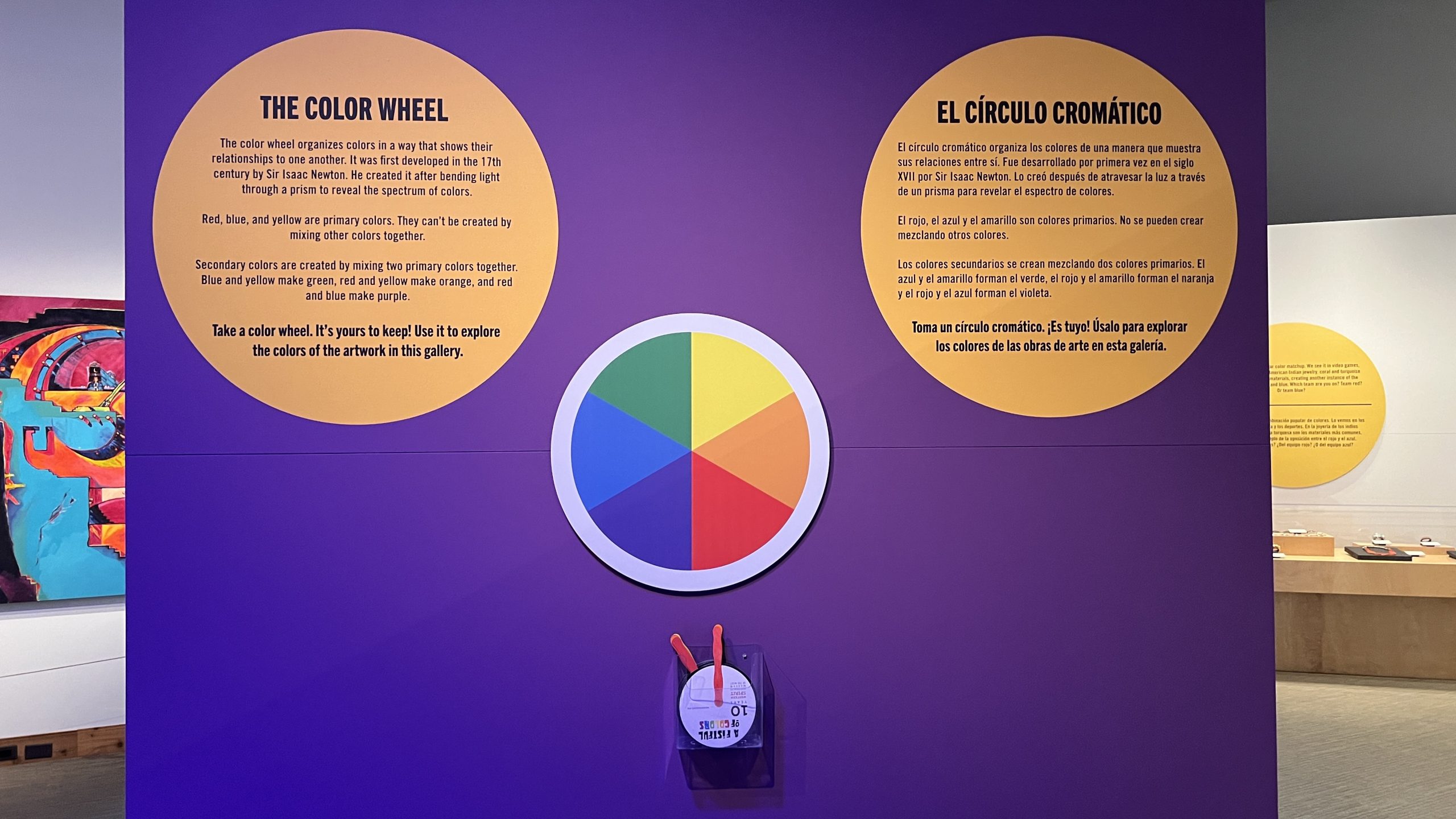
She was walking me through a gallery at Western Spirit: Scottsdale’s Museum of the West, explaining why one portrait feels serene and the one beside it feels loud, and somewhere between Isaac Newton’s prism and a wall of black-and-white photographs, I stopped taking notes about the West and started taking notes about color. That is not what I expected from a museum whose name has the word cowboy hovering behind it.
As a Design Tourist, I look for the places where a destination’s history shows up in material form — in the buildings, the objects, the hands that made them. Scottsdale calls itself the West’s Most Western Town, and I wanted to know what that claim looks like when a serious architect and a serious curator get hold of it. So I booked a docent tour and asked a simple question: what can a traveler who cares about art, architecture and design actually see here?
The answer took two hours and I still left early.
The Building Is The First Exhibit

Pull up to 3830 N. Marshall Way and the museum tells you what it is before you reach the door. The exterior wears intentionally rusted steel — weathering steel, the kind that oxidizes on purpose into a russet skin and then stops. The walls are concrete, inside and out. The palette is desert, the posture is modern, and the combination reads as Western without a single wagon wheel.
Phoenix firm Studio Ma designed it, and the building is LEED Gold certified — a rating that measures energy, water, materials and indoor environmental quality. A climate that spends five months above 100 degrees turns those thick concrete walls into thermal engineering, not just aesthetics.

Then our docent asked me to look at the walls again. Did the vertical fluting remind me of anything in the desert?
I did not get it. She told me: the ribs of a saguaro cactus.
Once you see it you cannot unsee it. And here is the detail that makes it a design story rather than a decorating story — those walls were poured flat on the ground and then lifted into place, a tilt-up construction method that turns each wall into a single cast panel. The saguaro fluting is not applied. It is how the concrete was formed.

Design takeaway: the best regional architecture borrows a structure, not a motif. Studio Ma did not put a cactus on the building. They put the cactus in the wall.
A Museum That Decided Not To Collect

Western Spirit opened in January 2015, which makes it young by museum standards — business leaders in Scottsdale had been lobbying for it for a decade or two before that. It became a Smithsonian Affiliate, a designation that gives it access to Smithsonian collections, scholarship and programming.
Here is the part that surprised me most, and it explains everything you will see: the museum started out intentionally not being a collecting institution. It was built to host exhibitions rather than accumulate them.
That decision has consequences a visitor can feel. Shows rotate on roughly annual cycles. Collections arrive on loan from private owners. Exhibits come in through relationships rather than acquisitions — one current show exists because an artist’s daughter-in-law, a cultural anthropologist, rediscovered her work and brought the whole exhibit to the museum’s door.
It also means the geography is wide. The museum’s subject is not Arizona. It is the West, defined generously — the Dakotas to Texas, west to the Pacific, plus Alaska and Mexico. There has been a show about Alaskan sled dogs.

The model has shifted somewhat. The museum opened the Louis Sands IV Center in March 2026, a 12,000-square-foot, $12 million addition funded by a gift from Scottsdale auto dealer Louis “Buzz” Sands IV, bringing the building to 55,000 square feet. It was built to house something the museum now does own.
Still In The Saddle: The Western Didn’t Die, It Morphed

A giant neon cowboy greets you at the entrance to this one. He used to stand outside a drive-in movie theater a couple of blocks south. Our docent said she asks visitors who has been to a drive-in, which sorts a room by age faster than anything else.
“Still in the Saddle: A New History of the Hollywood Western,” curated by the museum’s chief curator Dr. Andrew Patrick Nelson, runs through December 31, 2026, and it argues with something most of us believe. The conventional story says the Western peaked in the 1940s and ’50s with Gary Cooper and a young John Wayne, then died in the ’60s.
Nelson’s premise is that it did not die. It morphed — because we did.
Six screens run clips beginning around 1969. A timeline wall puts Nixon, Watergate and Vietnam protests alongside what was happening on screen. A section called Real Indians tracks films that began presenting Native people from inside their own cultures instead of as savage or sidekick. Another tracks the films that questioned the mythology outright — was Billy the Kid really the bad guy, and was Pat Garrett really the good one?

There is a corner devoted to Clint Eastwood, whom our docent calls the last man standing — first screen appearance in 1958, still directing. She repeats a line he gave a journalist on his 93rd birthday, when he was asked how a man that age starts a new movie: I wake up every morning and I don’t let the old man in.
I wrote that down twice.
Practical note: people sit on the benches in here and lose an hour. Budget for it.
The Louis Sands IV Center And The Eddie Basha Collection

The new wing exists largely because of a grocer.
Eddie Basha was an Arizona businessman whose family came from Lebanon and built a general store that Eddie grew into four grocery chains. He took a history degree at Stanford and meant to make history his life until his family called him home to run the business. He built grocery stores on Native American reservations that were functionally food deserts, donated a percentage of profits to the tribes, and gave heavily to arts education.

The way he kept hold of the history was by collecting art of the West. He had assembled a major collection by the time he died, and he hung it in his corporate headquarters in Chandler, open to the public, free, all the time, because he believed art was meant to be shared.
The Basha family announced a gift of more than 1,000 works spanning three centuries in October 2023, divided between the Heard Museum in Phoenix and Western Spirit. The Western Spirit portion now anchors “Working Pardners: Masterworks from the Eddie Basha Collection,” presented by the Zelma Basha Salmeri Art Foundation — the collection’s first public presentation here.
Because only a fraction can hang at once, the galleries rotate roughly every nine months to a year. Locals come back to see what changed.
The Paintings Tell Stories, Because That Is What He Bought
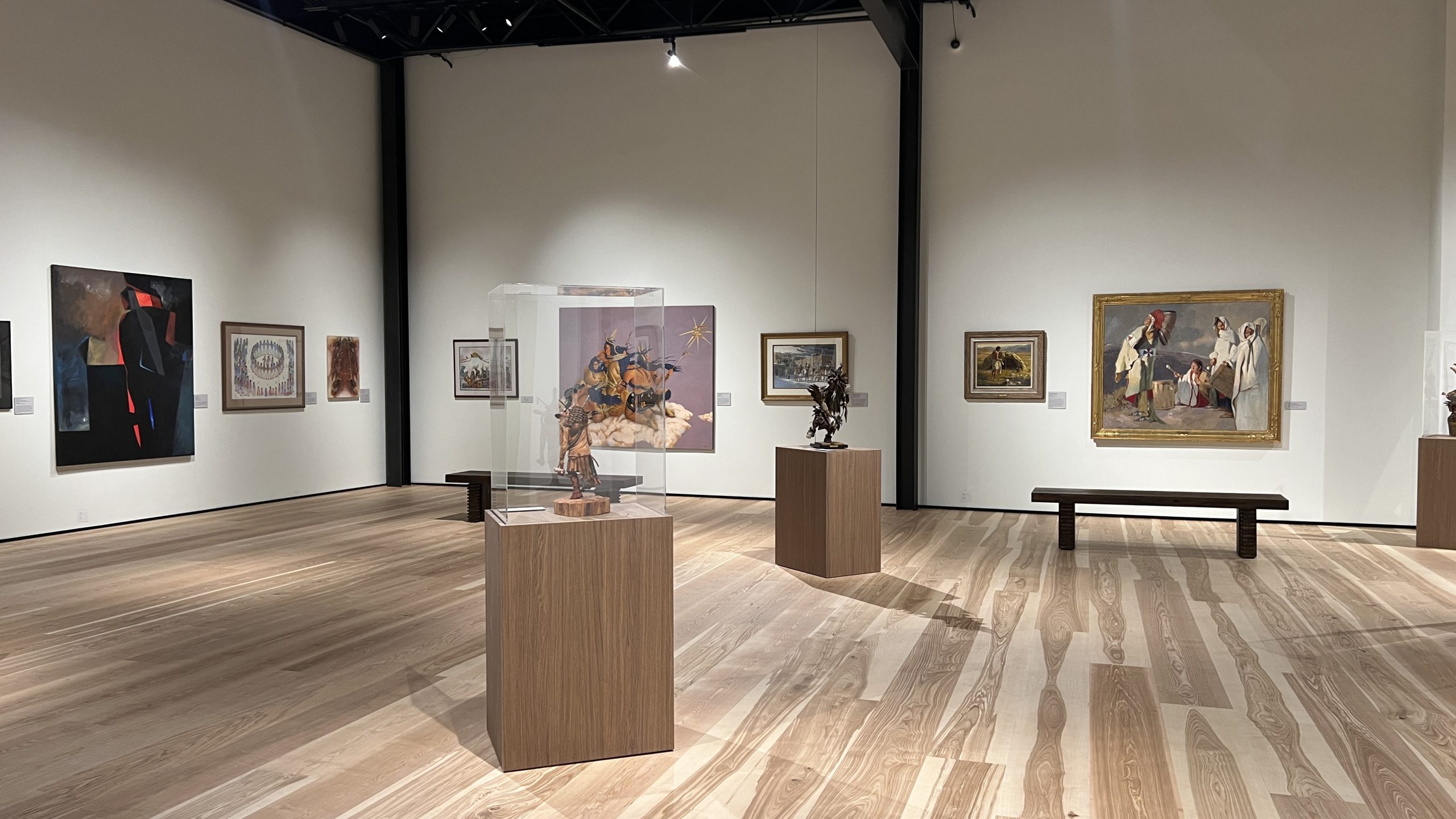
Basha did not collect soaring landscapes. He collected narrative — paintings that hold an event.
Our docent stopped in front of one called Turning the Leaders and asked what I thought was happening. I saw cattle and a cowboy. What I was actually looking at was a stampede management technique. Cattle drives ran anywhere from 1,500 to 2,500 animals from grasslands to railheads. A lightning strike or a predator sets them running, and you cannot stop two thousand animals head-on. So you ride to the front and turn the leaders, folding the column back on itself until the whole thing wheels into a circle and stops.
I have looked at a lot of Western paintings. I had never once understood that I was looking at a procedure.

Nearby hangs John Clymer’s Sheepeaters (1986), a portrait of the Mountain Shoshone — Tukudeka — whose territory ran through the Yellowstone high country. Clymer made a project of painting Native peoples in pre-contact life, and this one carries an economic detail most Western art skips: these people hunted bighorn sheep, and they worked the horns into bows stronger and more resilient than their neighbors could make. That made them a trade power.

Two bronzes in the collection are by Deborah Copenhaver Fellows. One is called Working Mom. The other is She Rode Good Horses, a title that comes from a verse about a woman who may not have moved the stars in their courses, but she loved good men and she rode good horses. The subject is an everyday ranch woman, rendered in a material historically reserved for gods and emperors.

Which is the whole argument of the medium, and the museum makes it explicitly in its bronze gallery: casting something in bronze declares it heroic. Point that tradition at a Comanche chief or a ranch hand in a work shirt and you have made a claim about who counts.
A Fistful Of Colors: A Color Theory Class In Disguise

This is the exhibit I did not expect and cannot stop recommending.
“A Fistful of Colors” is not organized around an artist or a period. It is organized around color itself — what it does, how artists deploy it, why one wall makes you exhale and the next one makes you sit up.
The tour starts at the color wheel, with the story of Newton putting apparently colorless light through a prism and getting seven colors out the other side. Then come the small paper color wheels, handed out to every visitor. Our docent notes that schoolchildren mainly use them to hit each other.
What follows is a genuine lesson, delivered in front of actual paintings:
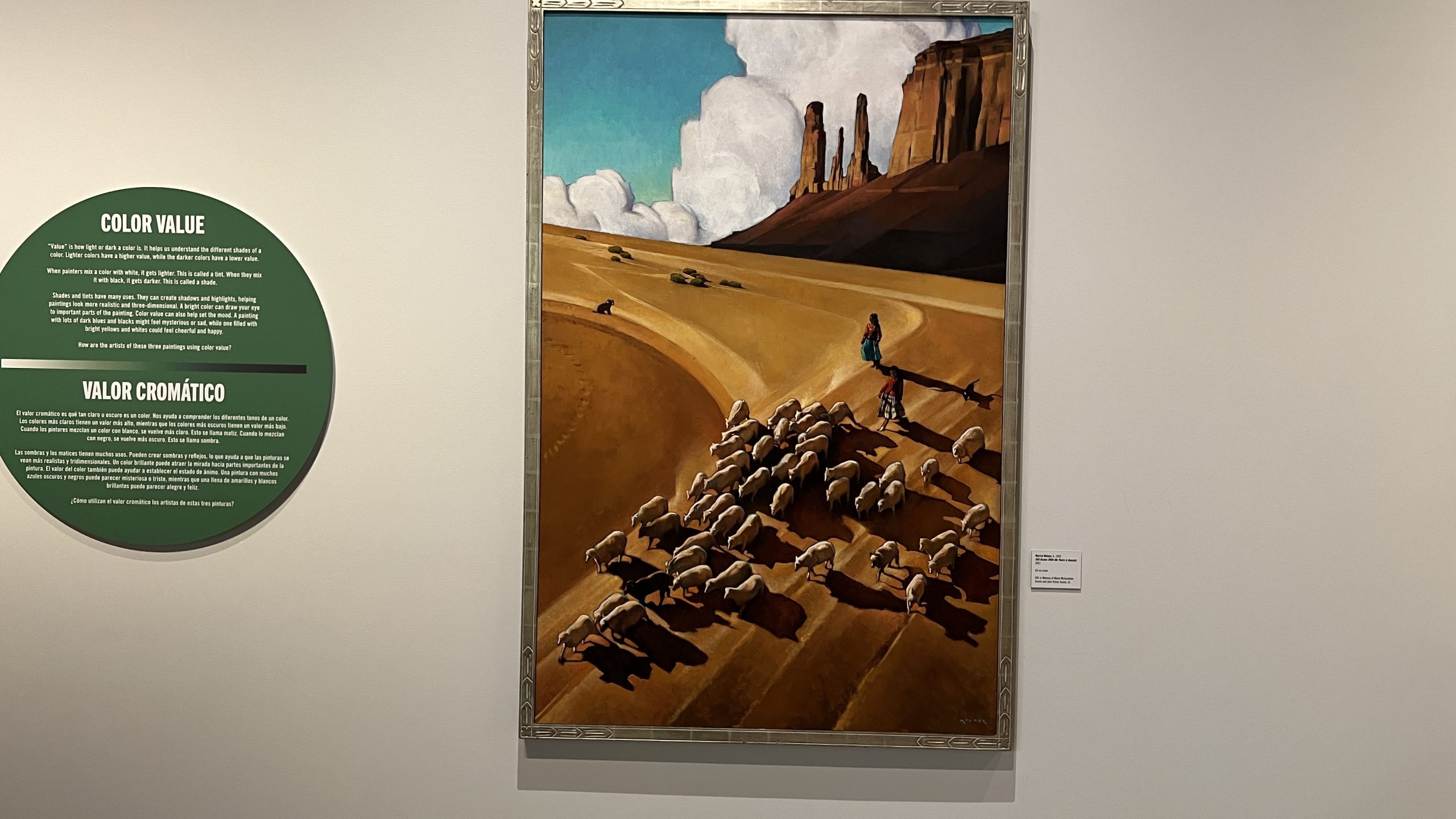
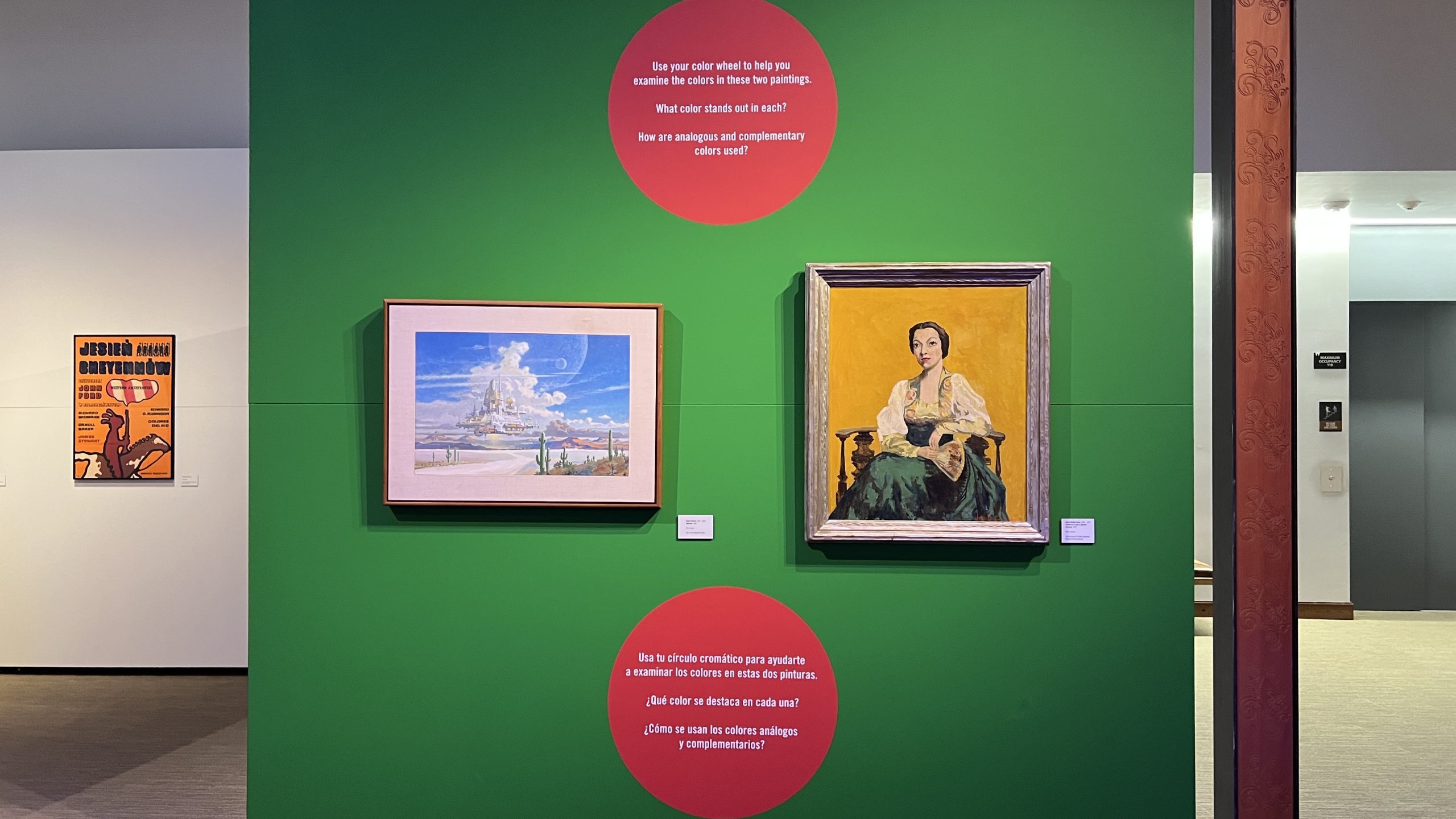
- Analogous palettes — neighbors on the wheel — blend and calm. That is why the serene portrait is serene.
- Complementary colors — opposites on the wheel — punch and direct the eye. A canvas of blues and greens with one deliberate stroke of orange tells you exactly where to look.
- Color value alone can build an entire painting. One brown-tan hue, white added for the raised textures, black for the shadows, and you get depth without a second color.
- Black and white removes color to expose texture and drama. Her advice, which I have now tried on my own photo library: open a color photograph on your phone, drop a black-and-white filter on it, and see what the image was actually about.
There is a wall running realism to impressionism to abstraction, and it is the clearest demonstration of the difference I have seen in a museum. The realists use the colors that were there. The impressionists use colors that were not — a lime-green sky conveying an impression rather than a fact. The abstractionists use whatever they want, which is why the docents put middle schoolers in front of those canvases and ask what they see.
And then she says the thing that turns an art lesson into a design lesson: you can use this in your living room. Serene sea greens and blues, or one contrasting red wall. Same wheel, same rules.
If you take one thing from this museum into your own house, it is this room.
Sculpture Is A Three-Dimensional Art — So Walk Around It

The sculpture gallery connects to a courtyard, and a sliding wall opens the whole thing to the theater for events. Sculpture, our docent points out, works outdoors as well as in.
Then she taught me how to look at it, using one piece.
Coming at Bill Nebeker’s bronze from the entrance, your view is the hind end of a horse, which she cheerfully concedes is not the best angle in art. Keep walking. Now there is a man in a cowboy hat holding binoculars, so something is being watched. Keep going. There is a rifle scabbard on the saddle, so maybe this is a hunt. Come all the way around to the front and the joke lands, and I am not going to spoil it, except to tell you the title is If Horses Could Talk.

Nebeker, a Prescott sculptor and a member of the Cowboy Artists of America, works humor into his bronzes the way other artists work light.
Design takeaway: a sculpture has no front. If you photograph it from one side you have photographed a third of the work.
A second Nebeker bronze, Comanche: Lord of the Southern Plains, sits in the bronze gallery — a Comanche chief given the bust-of-a-statesman treatment. The Comanche controlled enormous territory on the strength of their horsemanship, and the bronze is making that argument in a material that carries three thousand years of weight.
The museum explains bronze casting through the lost-wax method, and the claim you will hear is that the process has not changed since Michelangelo. The principle certainly has not — model in wax, burn it out, pour metal into the void — and it runs back millennia further than that, to gold objects cast some 6,500 years ago. Modern foundries do use ceramic shell molds and synthetic rubbers that no Renaissance workshop had. But the idea is genuinely ancient, and standing in front of the results, that is the part that lands.
Southwest Jewelry In A Gallery With Black Walls

The curators painted this gallery black, which is unusual for a museum and completely right. The room is meant to evoke a cave, and the darkness makes the silver and stone do what they do.
The jewelry on view comes from the Richard A. Gates Collection, and the material story is a Southwest story from the ground up. The silver and the turquoise were mined here.
The craft tradition begins around the 1850s, when Mexican silversmiths taught Navajo men to work melted silver coins — mostly Mexican pesos — into ornament. Atsidi Sani is generally credited as the first Navajo silversmith. Early work is chunky: big silver, big turquoise.

Turquoise carries meaning as well as color. It signifies protection and prosperity for the wearer, which is why you see it worn in quantity. And the stone itself is a geology lesson: turquoise contains copper as a required ingredient, which is why it forms in the alteration zones around copper deposits, and why every mine produces a different stone. The dark veining — the matrix — is the host rock showing through, and an experienced dealer can often name the mine from the pattern alone. One case held a turquoise so evenly, saturatedly blue that I said out loud it looked manufactured. It was not. It was simply from a mine with almost no matrix.
The materials multiply from there. Coral in deep orange. Spiny oyster in orange, red and purple. Lapis lazuli, that dense blue, traded in from Afghanistan. Onyx, mother of pearl, opal. And sugilite, the magenta stone, which comes almost entirely from the Kalahari Manganese Field in South Africa — a stone that did not exist in this jewelry tradition until a mine on another continent opened in the 1970s.
The technique evolves alongside the materials. Zuni artisans are known for inlay, stone set flush into silver in patterns fine enough to read as pixels.
What the display does best is show jewelry as a generational craft. The cases are organized by family — the Yazzie family among them — with fathers, sons and nephews each carrying a recognizable house style while pushing it somewhere new. Look at a father’s ring beside his son’s and you can see the inheritance and the argument at the same time.

My favorite piece in the room is a necklace with stilettos dangling from it. The title is White Woman Moccasins. I laughed out loud in a quiet gallery. It was, I am told, a commission.
How To Buy Authentic Native American Jewelry In Arizona
Our docent raised this unprompted, and it is the most useful practical advice I got all day: there is a great deal of counterfeit Native American jewelry sold in tourist shops.
The law on your side is the Indian Arts and Crafts Act of 1990, a truth-in-advertising statute. It is illegal to display or sell any art or craft in a way that falsely suggests it is Indian-produced or the product of a particular tribe. “Indian” means an enrolled member of a federally or state recognized tribe, or an artisan certified by a tribe. Penalties run to $250,000 and five years for an individual, $1 million for a business.
That is the teeth. Here is the practice:
- Buy where someone has already curated. Museum shops do this work for you. The Heard Museum shop puts the artist’s name on every piece.
- Buy from the artist. Two markets are the best in the country for it. The Heard Museum Guild Indian Fair + Market in Phoenix runs in March and draws over 600 Native artists. The Santa Fe Indian Market, produced by SWAIA, runs in August and is larger still, with artists from nearly 250 Indigenous nations.
- Ask for the artist’s name and tribal affiliation, and get it written on the receipt. A reputable seller will not blink.
- Turn it over. If it says Made in China, you have your answer.
One Cottonwood Root, Thirty-Nine Katsinam
The single object I would come back for is a carving by Hopi artist Wilmer Kaye.
Hopi katsina carvings — katsintithu — are made from cottonwood root, and the discipline of the form is that nothing is added. Whatever the figure is going to be, it has to come out of the one piece of root the carver started with. Our docent explained that cottonwood grows along water, which in this desert makes it a sacred material. I have not been able to source that symbolism to a Hopi authority, so I pass it along as she gave it to me.

Kaye found a root with a natural Y in it and decided to keep the shape intact. Then he carved thirty-nine separate katsina figures into it — including the mudheads, the Koyemsi, with their distinctive knobbed masks. The piece is called Salako & Crow Mother, it stands 55 inches tall, it took months, and it won Best of Show at the 1995 Santa Fe Indian Market.
A note on terms, because museum labels flatten this: katsinam are not gods. They are intermediaries — messengers between people and the spirit world, representing natural forces, ancestors, animals and deities. The Koyemsi occupy a slightly different category again, functioning as clowns between dance sets while doing quieter sacred work. The carvings are teaching objects, made to remind Hopi people of the qualities the spirits embody.
Which is a very different thing from a souvenir, and worth knowing before you shop.
Mac Schweitzer: A Maverick Rediscovered

Mac Schweitzer (1921–1962) was a painter who grew up in Cleveland and became, as thoroughly as anyone can, an artist of the desert. She worked in Tucson’s art community in the 1950s, and her palette is pure Sonoran — the colors of the flora, the fauna and the light.
Every summer she loaded her son into a pickup and drove to the Hopi and Navajo reservations, where they spent the season living with Native families. Her son played with the children. She learned the traditions. She painted what she saw.
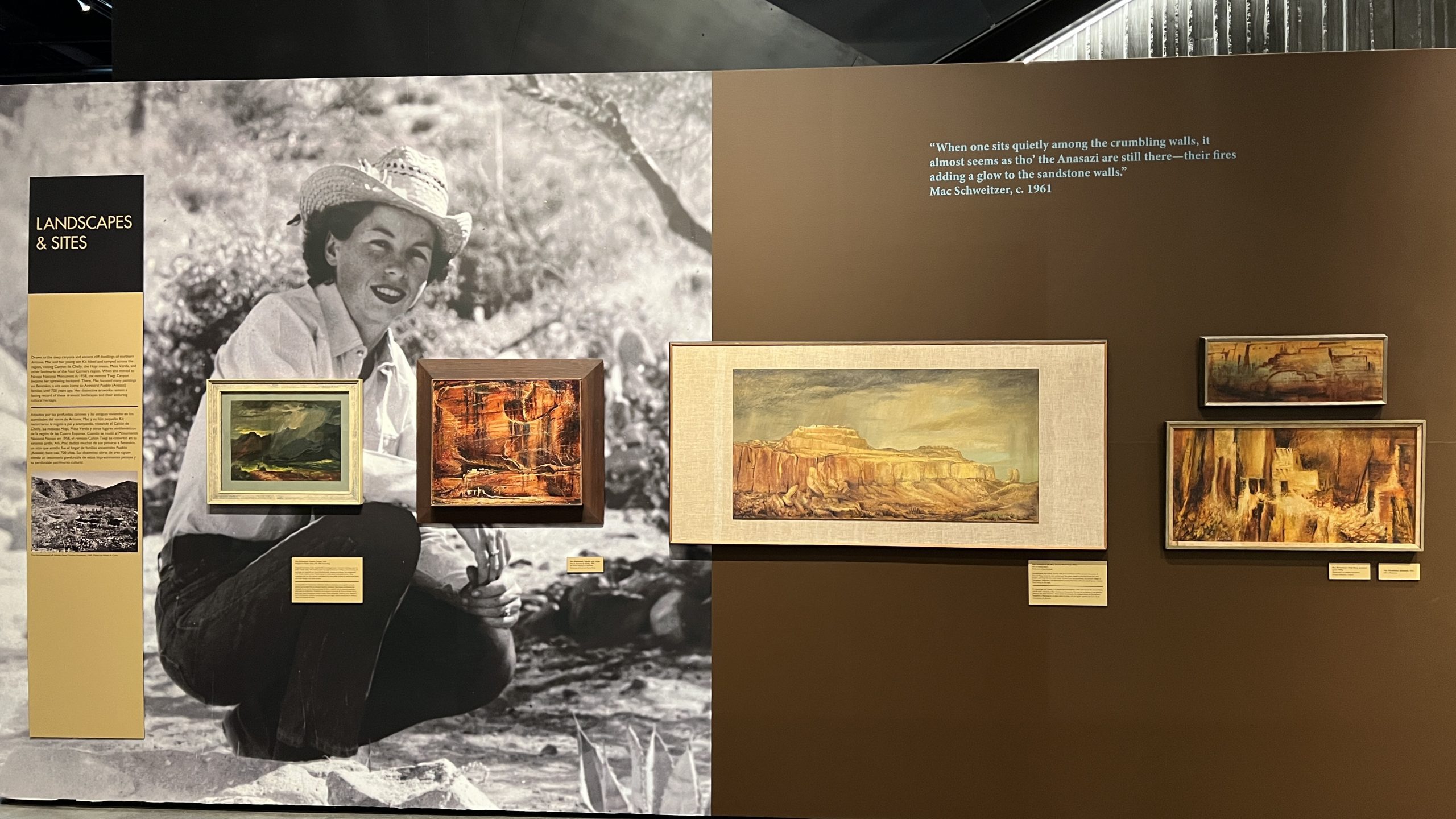
There is a wall of her animal paintings where she gives each creature a personality. An owl holds the center of one canvas, all strength and moody authority, and it takes a beat to notice he is not alone in the picture. There is a mouse. The mouse is lunch.
The exhibit exists because her daughter-in-law, a cultural anthropologist, rediscovered the work, assembled the show and the research, and brought it to the museum. That is how a forgotten artist gets a second life, and it is a reminder that art history is mostly a matter of who bothered.

“Mac Schweitzer: A Southwest Maverick Rediscovered,” guest-curated by Ann Lane Hedlund, closes September 27, 2026. If you are reading this in the next two weeks, go.
Guns, Saddles And Very Small Things

Two more galleries deserve your time, and they are frequently confused because they sit near each other.
The Abe Hays Family Spirit of the West Collection is roughly 1,400 artifacts of the working Old West, assembled over a lifetime by Scottsdale gallerist Abe Hays. Revolvers, rifles, saddles, knives, holsters, spurs, chaps, badges. Our docent’s read on visitors is that everyone finds their own door in — some people go straight to the guns, others spend the whole time on saddles.
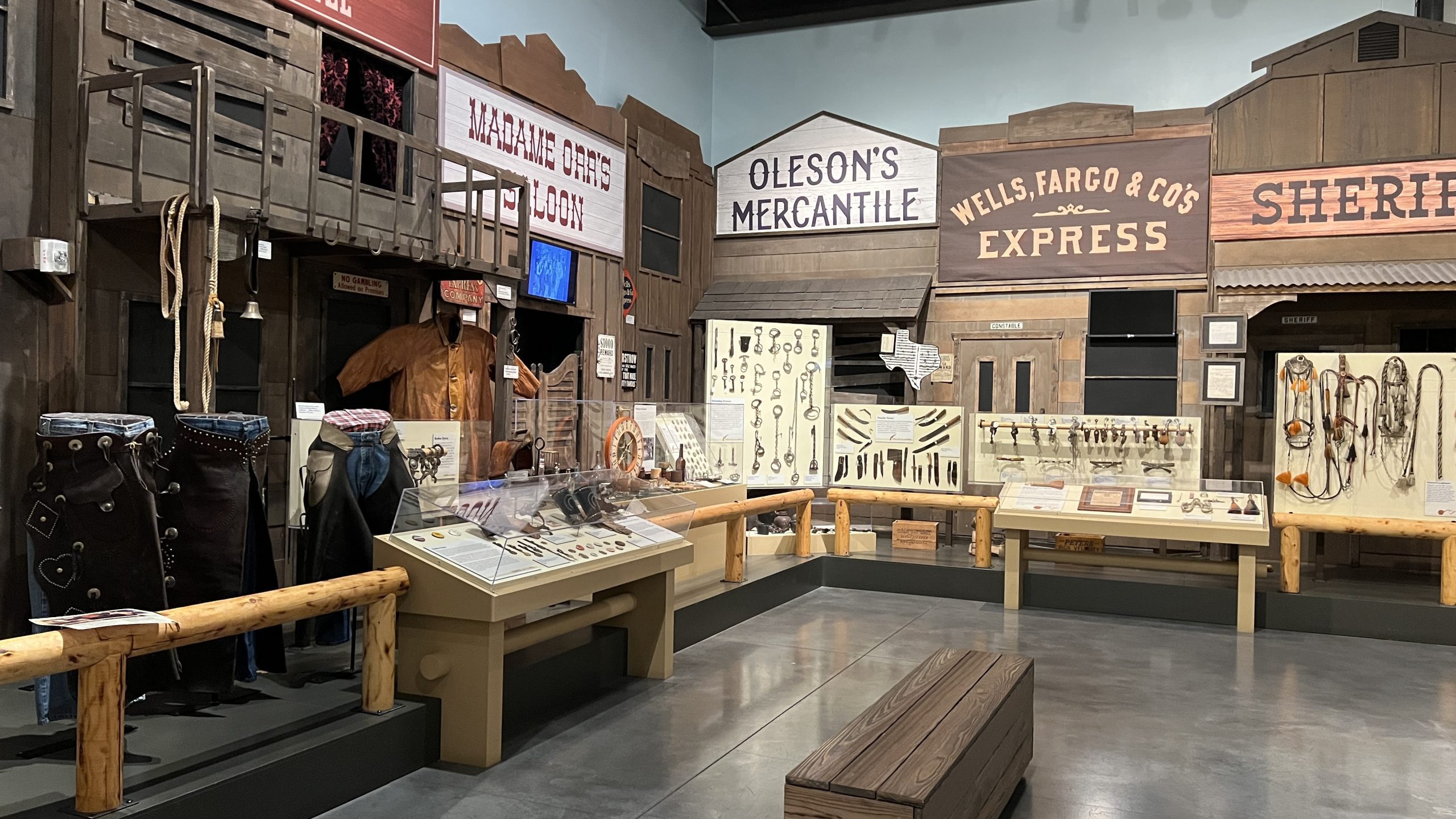
She also offered the best one-line economic history of the boomtown era I have heard. Silver or copper is found. Men rush in to get rich. The first building is the saloon. Once there is a saloon there is alcohol and gambling, so there are fights, so now you need a jail and a sheriff. And the only people who reliably got rich, she noted, were the shopkeepers selling everybody their supplies.
The West in Miniature is the separate gallery, and it is a delight. The art here is full quality at tiny scale — paintings, sculpture, ceramics, carvings, the kind of work that requires the magnifying glasses the museum provides. There is braided horsehair made by prisoners in territorial jails in the late 1800s and early 1900s. She assumed that craft had died out in favor of stamping license plates until a visitor from Montana told her they still do it there.
Know Before You Go: Tickets, Hours, Parking & Docent Tours

Location. Western Spirit: Scottsdale’s Museum of the West, 3830 N. Marshall Way, Scottsdale, Arizona, in Old Town’s arts district and walkable from the Scottsdale Arts District galleries.
Admission. Adults $28, seniors and military $25, youth and students $12, children five and under free.
Hours. Monday through Saturday 9:30 a.m. to 5 p.m., Sunday 11 a.m. to 5 p.m., with extended Thursday hours to 8 p.m. from November through April. The museum closes Mondays from Memorial Day through Labor Day.
Take the docent tour. This is my strongest recommendation. Four public tours run daily at 10:20, 11:20, 12:20 and 1:20, included with admission. The docents here are trained as storytellers rather than lecturers, and half of what is in this article came from a volunteer with a history background who works the floor twice a week.
Give it three hours. Two is the tour. The third is for going back through at your own pace.
Bring the kids, and the middle schoolers especially. The museum runs an active school program funded by a foundation grant that covers admission and even bus costs for Title I schools. The abstract wall in A Fistful of Colors is built for kids who have opinions.
Go up. The elevator is slow. Our docent called it the world’s slowest and she is not wrong. The galleries at the top are worth the wait.
Frequently Asked Questions
Is Western Spirit: Scottsdale’s Museum Of The West Worth Visiting If I Don’t Like Western Art?
That is close to the reason to go. The museum’s underlying argument is that Western art was long dismissed as genre work, and the exhibits are built to dispute that — through film history, color theory, contemporary sculpture and Native craft. A Fistful of Colors is a color theory exhibit that happens to use Western paintings.
How Long Should I Plan For?
Two hours for the docent tour, three if you want to revisit galleries and take photographs. The film exhibit alone can absorb an hour.
Is It Good For Kids?
Yes. The color wheel demonstration, the abstract paintings and the miniatures with magnifying glasses all work for children, and the museum runs a substantial school tour program.
What’s The Newest Part Of The Museum?
The Louis Sands IV Center, a 12,000-square-foot addition that opened in March 2026 and houses masterworks from the Eddie Basha Collection.
Where Should I Buy Authentic Native American Jewelry In Arizona?
Museum shops that document the artist — the Heard Museum shop is the standard — or directly from artists at the Heard Museum Guild Indian Fair + Market in March or the Santa Fe Indian Market in August. Ask for the artist’s name and tribal affiliation on your receipt.
Is The Museum Affiliated With The Smithsonian?
Yes. Western Spirit has been a Smithsonian Affiliate since its 2015 opening.
The line I keep coming back to is something our docent said in front of a sculpture, almost in passing: our mission here is to be storytellers. I’m not here to give you a college lecture.
You can feel that decision in every gallery. The paintings are hung because they hold a story. The bronzes are placed so you have to walk around them. The jewelry is grouped by family so you can watch a craft move one generation down the line. Even the walls are telling you something about a cactus.
Western Spirit is not a museum about the West. It is a museum about how the West gets told, and who gets to do the telling — and on that subject, it is still arguing.
Karen LeBlanc is an award-winning travel journalist and host of The Design Tourist, streaming on Amazon Prime, Tubi, Reveel, Vacation Escapes, and additional networks.
All photos by Karen LeBlanc.
Also Read:
Elevated Home Finds to Refresh Every Room
Travel Guide to Ecuador: Things To Know Before You Go
Investing in Your Wardrobe: Pieces That Hold Their Value