







China has some of the world’s most diverse urban design landscapes. Designers interested in looking around a few cities can see imperial axes and classic gardens, super-tall engineering, adaptive retail precincts, and museum architecture. Travellers looking for a design-led journey, the main interest is in diversity. Each destination provides a unique perspective on how China utilizes buildings, landscapes, and public spaces to create identities. Let’s discuss the best locations that are worth visiting because of their architectural and cultural visual elements.
Beijing: The Architecture of Imperial Order
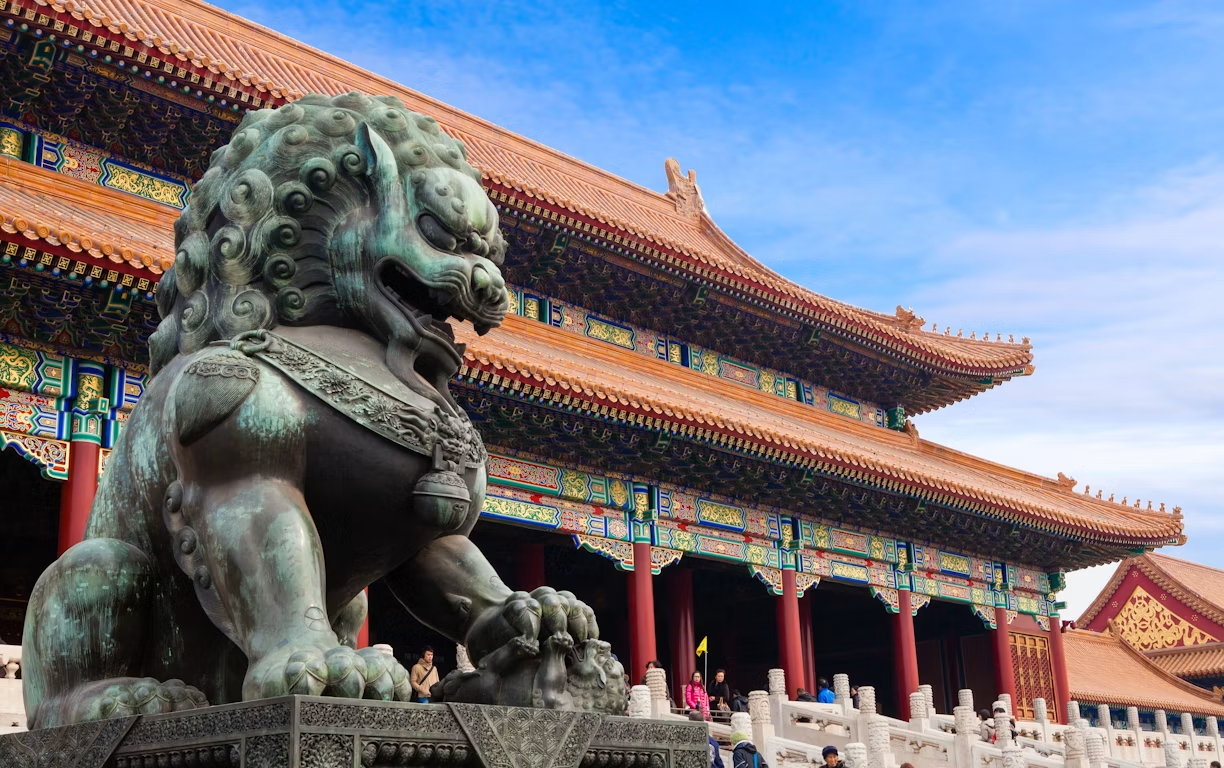
Beijing draws attention with its scale, symmetry and ceremonial plan for the city. Historically, the central axis of old Beijing is oriented north to south along the historical centre of old Beijing. It demonstrates long-standing Chinese beliefs about social hierarchy and urbanism. The Forbidden Palace continues to be an excellent example of traditional Chinese palace design. The building’s use of courtyards, timber-framed hallways, elevated platforms and symmetrical layouts exhibit how spatial organisation influenced the movement, status and ceremonial uses of the building. In contrast to that, modern Beijing has shifted the focus from understanding structure as an expression of cultural values to examining structural experimentation.
The three-dimensional loop created by OMA in the CCTV Headquarters adds new dimensions to Beijing’s skyline. As such, Galaxy SOHO, which was designed by Zaha Hadid Architects, provides flowing volumes for offices, retail spaces and entertainment venues connected by bridges and large open atriums, thereby offering a reinterpretation of the traditional courtyard concept using materials such as glass, aluminium, and continuous curves.
Shanghai: A Dialogue Across the Waterfront
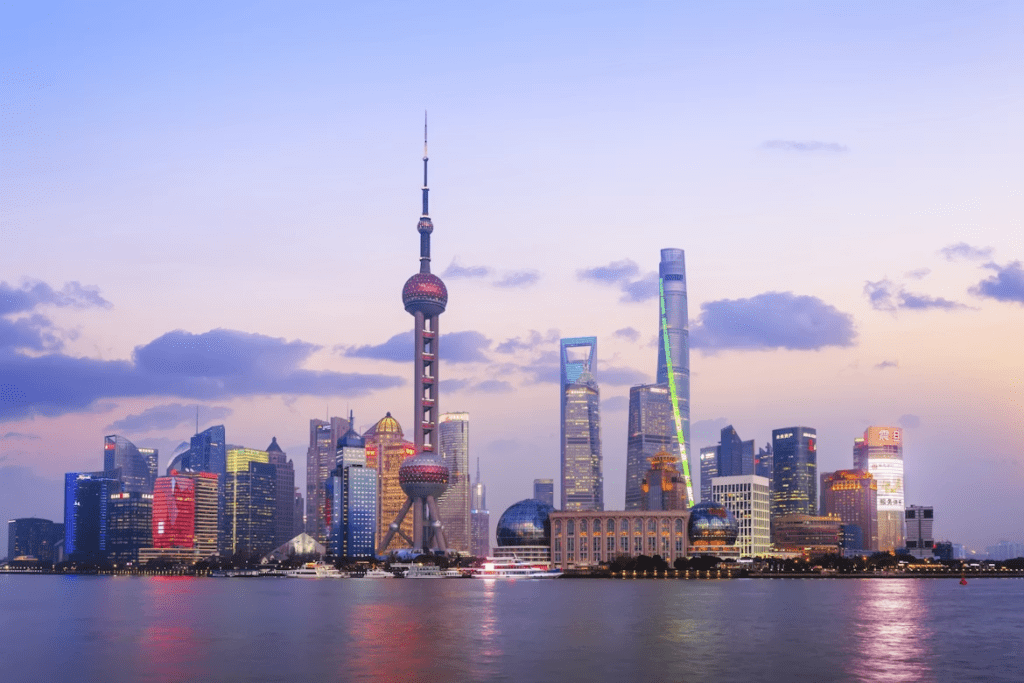
The most pronounced architectural contrast in China can be found in Shanghai, where the Huang Pu River separates two distinct urban narratives. The historic Bund, located on the western side of the river, has served as Shanghai’s first impression of foreign influence since the early twentieth-century construction of stone buildings that reflect its historical international commercial role. The architectural styles include Neoclassicism, Beaux-Arts, and an eclectic mix of Art Deco elements.
On the eastern side, directly across from the Bund, rises Pudong. As a result of rapid financial growth, this skyline is defined by contemporary tower design. The Shanghai Tower is perhaps the most notable example. Its façade twists 120 degrees as it rises, a design decision linked to reducing wind loads. Additionally, its double-skin glass façade allows for environmental performance through creating interior zones between the glass layers.
For design enthusiasts, the former French Concession provides a different scale. Tree-lined streets lined with historic villas and old shikumen houses, along with independent cafes and boutique shops offering design-led goods, provides a much slower and more deliberate visual rhythm. Because visitors can view the grandeur of a waterfront location, the ambition of commercial development and neighbourhood creativity, Shanghai makes for an ideal travel destination.
Shenzhen: The Blueprint of Contemporary Growth
Shenzhen is one of China’s most dramatic urban transformation stories. Once a border town near Hong Kong, it became China’s first special economic zone in 1980 and has grown into a major technology and design hub with more than 18 million permanent residents. It is also recognised by UNESCO as a City of Design.
The Futian cultural district captures this energy well. The Museum of Contemporary Art and Planning Exhibition, often known as MOCAPE, brings two cultural institutions into one architectural complex. Designed by Coop Himmelb(l)au, the building is known for its angular form and central Cloud element, which organises the interior experience.
Some of the appeal of Shenzhen lies in how new and recent it all feels. New civic buildings and public spaces often emphasise glass, steel, greenery, plazas and pedestrian movement. Shenzhen shows how architecture, infrastructure and public space can project a future-focused identity.
Suzhou: Precision in the Classical Landscape
Suzhou provides a calmer counterpoint to China’s modern megacities. The city is known for classical gardens, several of which are listed by UNESCO as outstanding examples of Chinese Mountain and Water garden design. The Humble Administrator’s Garden and the Lingering Garden show how landscape and architecture work together.
These gardens use winding paths, pavilions, ponds, rockeries, white walls and carefully framed views to shape the visitor’s perception of space. A small garden can appear expansive because nothing is revealed all at once.
The city also bridges past and present through the Suzhou Museum, designed by I.M. Pei. The building draws from Jiangnan traditions, especially white walls and dark rooflines, but translates them into a clean modern language. Its courtyards and water features show how regional heritage can be modernised without imitation.
Hangzhou: Balancing Nature and Civic Architecture
Hangzhou demonstrates how a major city can remain visually anchored by a natural and cultural landscape. West Lake is at the heart of this identity. UNESCO has identified the lake and surrounding causeways, bridges, pagodas, gardens and wooded hillside as influencing landscape design in China and globally.
Around West Lake, the strongest impressions are subtle. A bridge sits low against the water. A pagoda becomes a vertical marker in the distance. Trees and pathways guide the eye without overwhelming the scene. Away from the historic lake area, Hangzhou’s modern civic architecture becomes more assertive. The Hangzhou Grand Theatre, designed by Carlos Ott, sits near the Qiantang River and is known for its sweeping crescent-like form. Nearby, the Hangzhou International Conference Centre is often associated with a golden sun-like appearance.
Moving Between Design Hubs
Travellers will find it much easier to develop an itinerary for this trip when the role of each city is clearly defined. Beijing and Shanghai work well together for the strongest contrast between imperial planning and modern skyline design. Suzhou and Hangzhou are good additions to the itinerary as they are both relatively close to Shanghai and easily accessible via train. Because Shenzhen is located further south, travellers can either take a longer rail journey or choose a domestic flight if time is limited. China’s high speed rail system can be used to connect many of these cities.
Planning Your Design Trip
Travellers who see past landmarks can experience how these places were shaped in the first place. There are many Chinese cities that have visually striking designs on all scales. From ancient urban planning principles to the composition of gardens, waterways to skyscraper-lined shorelines, museums to daily street life, there is no shortage of ways to observe and be inspired by this great country’s designs. While travelling, you will find that it isn’t the individual styles that create the memories, but rather how the old exists with the new. For anyone who travels with an eye for architecture, atmosphere and detail, China offers a route filled with contrast, texture and lasting visual inspiration.