



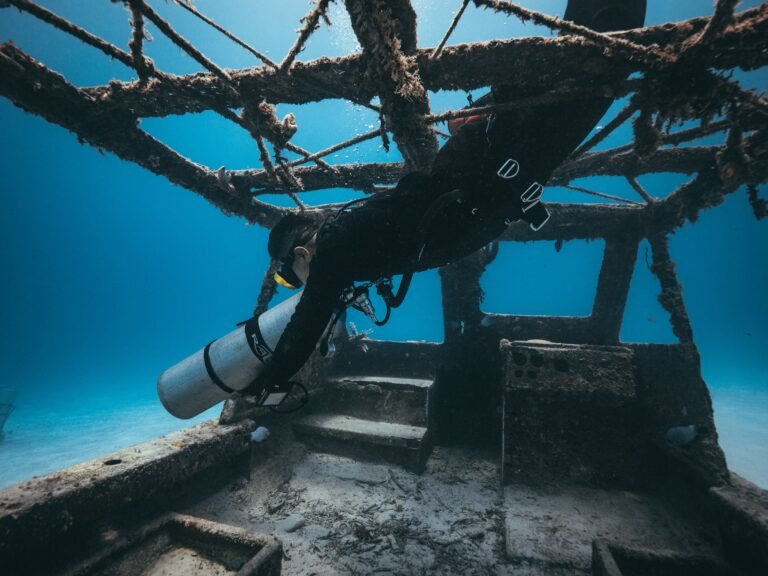
Rivets, decks, and steel beams — once symbols of progress — now form an underwater museum. Shipwrecks are more than maritime relics; they’re portraits of industrial design, preserved in the ocean’s stillness. Each wreck tells a story of craftsmanship and transformation. Diving them demands dependable scuba gear — the modern echo of the innovation that built these vessels.
The Artistry of Engineering — When Function Becomes Form
Shipbuilding has always balanced necessity and imagination. The sleek hulls of liners, the reinforced frames of warships, and the wide decks of freighters all reveal their era’s design priorities — efficiency, strength, or comfort. Underwater, stripped of movement and sound, their geometry changes character. Curved steel and propeller blades resemble sculpture, while beams and bulkheads take on architectural symmetry.
Design survives decay. Light flickers through broken windows and across stairwells, turning once-functional spaces into art. Engineering and aesthetics merge as coral softens the edges of human invention.
Notable Wrecks That Define Underwater Design History
SS Thistlegorm (Red Sea) — A WWII cargo ship carrying locomotives, motorcycles, and ammunition, the Thistlegorm now rests as a frozen workshop of wartime engineering. Its cargo bays display utilitarian beauty in rivets, machinery, and reinforced joints designed for endurance.
USNS General Hoyt S. Vandenberg (Florida Keys) — Once a troopship and later a missile-tracking vessel, it was sunk intentionally as an artificial reef. Long corridors and radar dishes form a geometric underwater labyrinth — industrial design transformed into living architecture.
HMHS Britannic (Greece) — Titanic’s sister ship, built with Edwardian precision and symmetry, now rests as an immense underwater monument to early 20th-century engineering. Even in ruin, its balance and proportion remain striking.
Time has softened all three, layering corrosion, coral, and sediment over metal — blending human construction with natural design.
From Decay to Design Rebirth — The Reef Effect
Rusted iron yields to saltwater, and coral and sponges take its place. Abrasion from the sea transforms a bulkhead into a garden, and fish swim through the hatches they once filled with ammunition. An apostle of industry’s triumphs becomes a cathedral of nature’s pageantry.
For decades, wreck diving has served as both an inspiration and a model for artificial reef programs worldwide, a controlled means of returning decommissioned machines to their roots on the seabed. For generations, industrial design ruled the waves; now, it serves them. Fashion and function both give way to form.
Cultural Heritage, Floating Out of Time
But cultural preservation is only part of the story. Wreck diving also serves as a rare archaeological viewpoint on the evolution of technology: from hulking naval vessels to reborn seascapes. Where once divers and researchers might have viewed these sunken ships as artifacts of marine and maritime history, they’ve assumed a poignant new significance as icons of the industrial age and emblematic of the ocean’s capacity for resilience.
Wrecks including the Thistlegorm and Britannic are more than engineering firmaments — they are worlds beyond worlds, separated not by distance, but by time.
Beauty in Rust and Resilience
Every wreck on the seafloor tells two stories: one of human innovation and one of aquatic endurance. The ocean did not do away with this technology; it made way for it. It’s given a new voice to the art of industry.
These vessels have sunk and have faded, natural markers of mankind’s innovation and resilience. But a ship does not destroy design by sinking — it continues its legacy, in testimony to the ocean, to light, to coral. Below the waves, art and creation communed again, showing the true secret of innovation: that in nature, when something great rusts, it only transforms into beauty.