


For many travelers, the Vatican has always been a place of timeless beauty, spiritual depth, and unmatched artistic heritage. Yet moments arise when history feels especially alive, when tradition meets the present in a way that makes a visit truly meaningful. Today, Americans have a new and powerful reason to experience the Vatican firsthand: the election of an American Pope and the unveiling of a newly created mosaic portrait that will soon become part of Rome’s eternal visual narrative.
Experience the Best Vatican Tours During a Historic Moment
With global attention focused once again on Vatican City, this is an extraordinary time to explore its museums, chapels, and basilicas with expert guidance. Choosing one of the best Vatican tours allows visitors to move beyond surface-level sightseeing and truly understand the art, faith, and history shaping this pivotal moment for the Catholic world.
The recent presentation of a new mosaic portrait of Pope Leo XIV marks a continuation of a centuries-old tradition. After the election of each Pontiff, a mosaic likeness is created by the Vatican Mosaic Studio and installed in the Basilica of St. Paul Outside the Walls, joining a long line of papal images that visually narrate the history of the Church.
This latest mosaic is not simply a decorative addition. Crafted using ancient techniques with thousands of hand-cut glass and gold tesserae, it represents the continuity of artistic excellence that has defined Vatican craftsmanship for generations. At the same time, it reflects something new: the presence of an American Pope within a tradition that has historically been European in character.
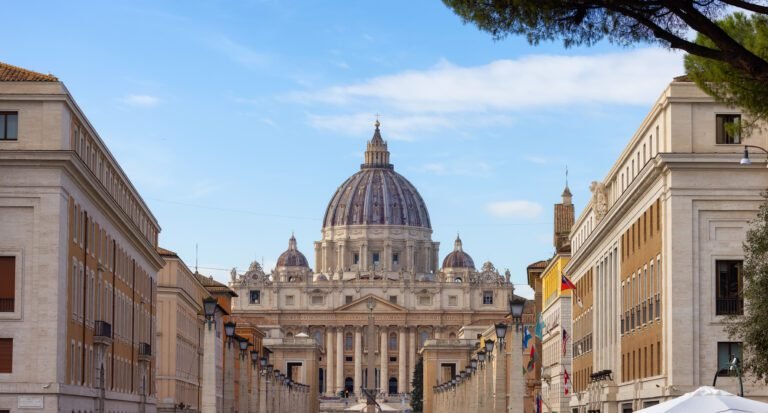
For American travelers, this detail resonates deeply. Visiting the Vatican now is not only about admiring Michelangelo’s Sistine Chapel or walking beneath Bernini’s colonnade in St. Peter’s Square. It is about witnessing a living chapter of history that includes their own national story.
Rome has always been described as an open-air museum, but the Vatican functions as its spiritual heart. Every artwork, corridor, and sacred space tells a story that spans centuries. The addition of the new papal mosaic reminds visitors that the Vatican is not frozen in time. It continues to evolve, responding to the present while remaining anchored to its past.
This sense of continuity is especially powerful for those visiting from the United States. Standing beneath mosaics that depict popes from across Europe, Africa, and the Middle East, and now knowing that an American Pontiff has joined this visual lineage, creates a unique emotional connection that cannot be replicated through books or screens.
Beyond its symbolic meaning, the Vatican remains one of the most immersive cultural experiences in the world. From the Vatican Museums to the Sistine Chapel and St. Peter’s Basilica, visitors encounter layers of art, theology, politics, and human creativity. Each space builds upon the next, culminating in an experience that is both overwhelming and deeply moving.
Travelers who visit during moments of transition—such as the beginning of a new papacy, often describe their experience as more intense and memorable. There is a heightened awareness, a feeling of being present at a turning point, even if the changes are subtle and unfold over time.
For Americans planning a trip to Italy, incorporating the Vatican into their itinerary has always been essential. Now, it carries an added dimension: the opportunity to witness how a global institution acknowledges and celebrates a Pope whose roots lie across the Atlantic.
The new mosaic, soon to be installed high within the Basilica of St. Paul Outside the Walls, will quietly observe generations of future visitors. Those who travel to Rome today can say they were there at the moment it entered history, when tradition and modern identity intersected in marble, gold, and glass.
In a city defined by layers, this is one layer that speaks directly to American travelers. Not as outsiders looking in, but as participants in a shared and evolving story.