


A Mediterranean sailing holiday changes how you experience culture. Cities are impressive on foot — but some of the region’s most unforgettable architecture was deliberately designed to be approached from the sea. Monks, pirates, merchants and emperors all understood one truth: in the Med, the horizon was the main road.
Drop anchor in the right bay and you don’t just visit history — you arrive the way travellers did a thousand years ago.
Here are some of the most spectacular cultural sites best experienced under sail.
Monasteries Built for Sailors, Not Roads
The Mediterranean is full of cliff-top monasteries, but a few were essentially maritime landmarks — spiritual lighthouses for passing sailors.
One of the most striking is San Fruttuoso Abbey, hidden in a tiny cove between Camogli and Portofino. Built between the 10th and 13th centuries, the Romanesque complex sits directly on the beach in a bay with no road access; historically, the sea was the only realistic way to reach it.
On a yacht, you understand why: the twin arches rise from the sand like a fortified gateway for pilgrims arriving by boat. From land it feels remote — from the water it feels inevitable.
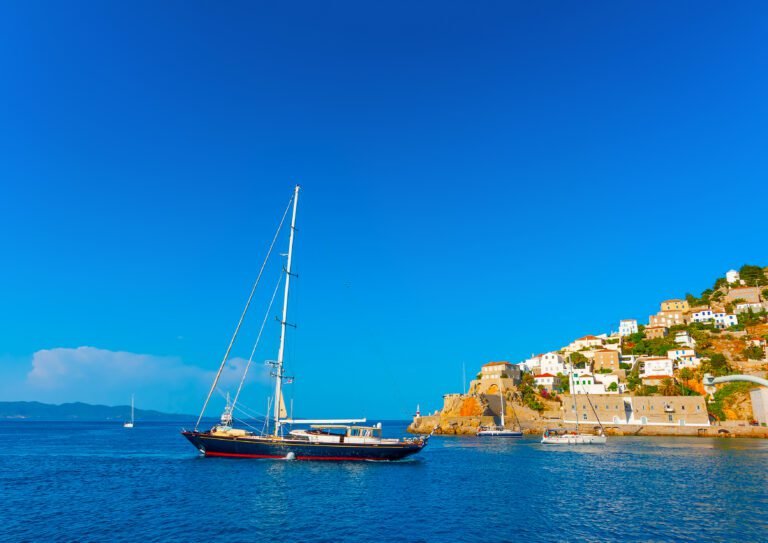
Further east, a catamaran charter in Greece perfects the idea. The tiny harbour village of Loutro on Crete remains accessible only by sea, preserving its whitewashed architecture because cars never arrived.
Approach under sail and it looks less like a village and more like a stage set — the Mediterranean before asphalt existed.
Sacred Structures on Impossible Rocks
Mediterranean religion evolved alongside seafaring. Isolation meant devotion, and the sea provided isolation.
Perched 35 metres above the Libyan Sea is Chrysoskalitissa Monastery, a 17th-century monastery overlooking historic landing coves once used by sailors arriving from the west.
From land it’s dramatic.
From a boat it’s cinematic — the building floats above the cliffs like a vision.
Sailors historically navigated by landmarks like this. In many ways, monasteries doubled as navigation aids: unmistakable silhouettes guiding ships long before charts were accurate.
Sea Caves Turned Cultural Icons
Some architecture isn’t built — it’s discovered.
Across the Mediterranean, coastal caves became shrines, gathering places, and myth-making locations because they could only be entered from water.
The glowing cavern of Blue Grotto can only be entered lying flat in a small rowboat through a one-metre-high opening at calm tide.
Romans placed statues inside — effectively turning a natural chamber into an underwater temple.
In Greece, the vast Blue Cave is even larger and likewise reachable only by boat when seas are calm.
These spaces blur the line between architecture and geology — which is exactly how ancient sailors experienced the world. Sacredness wasn’t built; it was found.
Landscapes Framed by the Sea
Some places are famous precisely because you cannot walk into them.
The dramatic cove of Navagio Beach is enclosed by sheer cliffs and accessible only by sea, giving it an isolated, almost theatrical quality.
Likewise, along Italy’s Amalfi Coast, hidden inlets and grottoes — including emerald-lit sea caves and fjord-like coves — reveal their full scale only from the water, the perspective they were naturally “designed” for.
From land they’re viewpoints.
From a yacht they’re entrances.
Why Sailing Reveals the Real Mediterranean
Most Mediterranean architecture isn’t oriented toward streets — it faces the horizon. Ports were front doors, not back entrances. Approaching by boat restores the intended narrative:
You don’t visit the site.
You arrive at it.
Bell towers become beacons.
Monasteries become refuges.
Caves become cathedrals.
A sailing holiday isn’t just transport — it’s time travel, letting you experience culture exactly as traders, pilgrims and explorers once did: emerging from open water and discovering civilisation carved into rock.
And once you’ve done that, arriving by car never feels quite right again.