




This post contains affiliate links. If you buy through them, I may earn a small commission at no extra cost to you. I only recommend gear I actually use and love. See my full disclosure here.
A ski town’s best-kept secret is its off-season — wildflower meadows, a glass observatory at 11,166 feet, mountain goats against bare rock, and a foot of snow in late June that a hundred college football players played in wearing Crocs.
Megan Munley, Big Sky Resort’s PR Director, told me a story I have not stopped thinking about.
Two days before July — technically summer, calendar-certified — Big Sky Resort got a foot of snow on top of Lone Peak. That same day, about a hundred Montana State football players came up to see the resort’s new summit observatory.
“They went to the top. They were in shorts,” said Munley. “One of them was in Crocs. Wasn’t even in sport mode Crocs. They just slid their Crocs on. And then they started making snow angels, and I was like, oh my gosh, you guys are in a T-shirt and sweatshirts just making snow angels at the top of Lone Peak.”
I have been thinking about it because it is the most efficient possible answer to the question I came to Big Sky to ask: what is a ski resort for in July?
The answer, it turns out, is quite a lot. What surprised me most is that summer here is not the consolation prize. Ask the people who live in this valley year-round and a striking number of them will tell you what Munley told me, slightly sheepishly, over lunch:
“Dare I say summer’s my favorite season? It really is.”
First, The Case For Summer Over Winter
I want to start with the practical argument, because it’s the one nobody makes and it’s the strongest one.
Winter at a ski resort is magnificent, and it is also narrow. As Munley put it: “In the winter, you have skiing, you have snowboarding, and that’s kind of it. You could also do snowmobiling, but then you’ve got to factor in all these extra things.”
Those extra things add up fast. Snowstorm driving conditions. Whether the road to Yellowstone is open. Whether you’re comfortable behind the wheel in the weather, and if not, how you’re getting a shuttle. Gear. Lift tickets. Lessons, if you’ve never done it.
Summer removes almost all of that friction.
“This summer, I feel like, is just a great time for people who are starting to explore the outdoors,” Munley said. “Obviously you want to carry bear spray. But other than that, there’s not too much else that you have to really worry about. It’s not like you have to factor in snowstorm driving conditions. So it’s pretty accessible, I would say.”
Cheaper, too. Summer lodging in Big Sky costs a fraction of ski season. And the town — which is what actually comes alive in July and August — is a short drive from everything.
Here are the six encounters I’d plan a trip around.
1. Stand On Glass At 11,166 Feet

For most of Lone Peak’s history, the summit belonged to people with skis, ropes, or exceptional lungs. That ended on December 20, 2025, when Big Sky Resort opened Kircliff, a two-story glass observatory at 11,166 feet — the highest scenic overlook in Montana — along with the Explorer Gondola on the same day.

Getting there takes about fifteen minutes and no athletic ability whatsoever. You ride the Explorer Gondola, billed as the world’s fastest 10-person gondola, up to the mid-mountain, walk a short paved path, and board the Lone Peak Tram, which climbs 2,142 vertical feet in roughly four minutes.

Then you walk out onto a glass ledge cantilevered over the edge of the mountain and ask your nervous system to be reasonable about it.
The view takes in ten-plus mountain ranges, three states, and — on the southern horizon — Yellowstone National Park. I stood there and did the thing everyone does, which is take one careful step onto the transparent floor and then look at my own boots suspended over two thousand feet of nothing.

What makes it a summer experience specifically: the rock.
“A lot of times you can see the mountain goats a bit easier because they’re white, and so you see them against the rocks,” Munley said. “People that come here in the winter don’t realize how much rock is at Lone Peak. It’s basically the whole way up. There are little spots of green, but not many. In winter, everything is covered in snow. So you wouldn’t even know there’s rock underneath.”
Winter gives you a white pyramid. Summer gives you the actual mountain — its structure, its geology, its resident goats. Completely different peak.

And here’s the detail I most want people to know: in summer, Kircliff is fully ADA accessible. A 517-foot paved path with a maximum grade under 5 percent connects the gondola’s upper terminal to the tram.
“I was up there two weeks ago with someone in a power wheelchair,” Munley said. “And they did it, which is amazing.”
A summit that until recently required mountaineering is now reachable by wheelchair. That is a genuinely remarkable sentence, and it is only true in summer, when the path isn’t under snow.
The engineering, briefly: the current tram went in for the 2023–24 season, replacing a 15-passenger cabin with two that hold 75. Building an observatory on top of that meant flying materials — including a tower crane — to 11,166 feet by Chinook helicopter, and engineering for the temperature swings, wind and storms that a peak like this generates as a matter of routine.
2. Walk Into A Wildflower Meadow
If you ask a local where to see wildflowers in Big Sky, you will get one answer, immediately, without deliberation.
“In Big Sky, Beehive Basin,” Munley said. “That’s the trail, and there’s a little lake at the top of that one as well.”
It runs roughly 6.6 to 7.2 miles round trip with about 1,600 to 1,700 feet of climbing, through meadows and up to an alpine lake sitting in a glacial bowl under jagged peaks. Munley rates it moderate to difficult depending on your hiking fitness — and offers the standard local caveat:
“It does get pretty busy, so definitely go earlier if you can, or go on a weekday.”
Bloom runs from late June through August, with Indian paintbrush carrying the color later into the season. September brings a different palette entirely.
Pair it with a shorter one. The Ousel Falls Park Trail is about 1.7 miles round trip to a waterfall, roughly four minutes from Town Center — the one, as Munley put it, you do with “the parents or grandparents and the kids.” Beehive Basin’s trailhead is about fourteen minutes from Town Center, so the two are fifteen or twenty minutes apart. Ambitious people do both in a day.
And then there’s the version of this that requires knowing someone. Munley’s sister was visiting the week we spoke, and had never seen Montana in summer:
“We’re going to go on a hike that ends in a mountain lake, that no one else is around. And I’m going to take her there and swim in that lake, which is going to be so much fun.”
That’s the summer Big Sky. Not a lift line. A cold lake nobody else found.
3. Get On The Water

This is the encounter that most surprised me, because I had filed Big Sky under “mountains” and not “water.”
Southwest Montana sits among the best cold-water trout rivers in the country — the Gallatin, the Madison, the Yellowstone. Snowmelt keeps them cold and oxygen-rich. Drive US-191 through Gallatin Canyon in daylight in July and you will pass outfitter after outfitter, and anglers standing in the river every few hundred yards.
“Right now it’s kind of peak time for the whitewater rafting, whitewater kayaking, and then the fishing as well,” Munley said.
She also offered a detail I loved, about the people who do this in the off-season: “You’ll still see them when it gets to be November, December. They’re just suited up in coats.” For anyone easing into it, though, her advice is straightforward — July and August are simply more pleasant, “however, the water is still really cold.”
Fair warning taken.
For something gentler, Lake Levinsky sits about a mile and a half from the lifts near Mountain Village, with paddleboard, kayak, canoe and pedal boat rentals. It is the low-commitment water encounter: a flat lake, a mountain behind it, an afternoon.
4. Ride The Bike Gondola

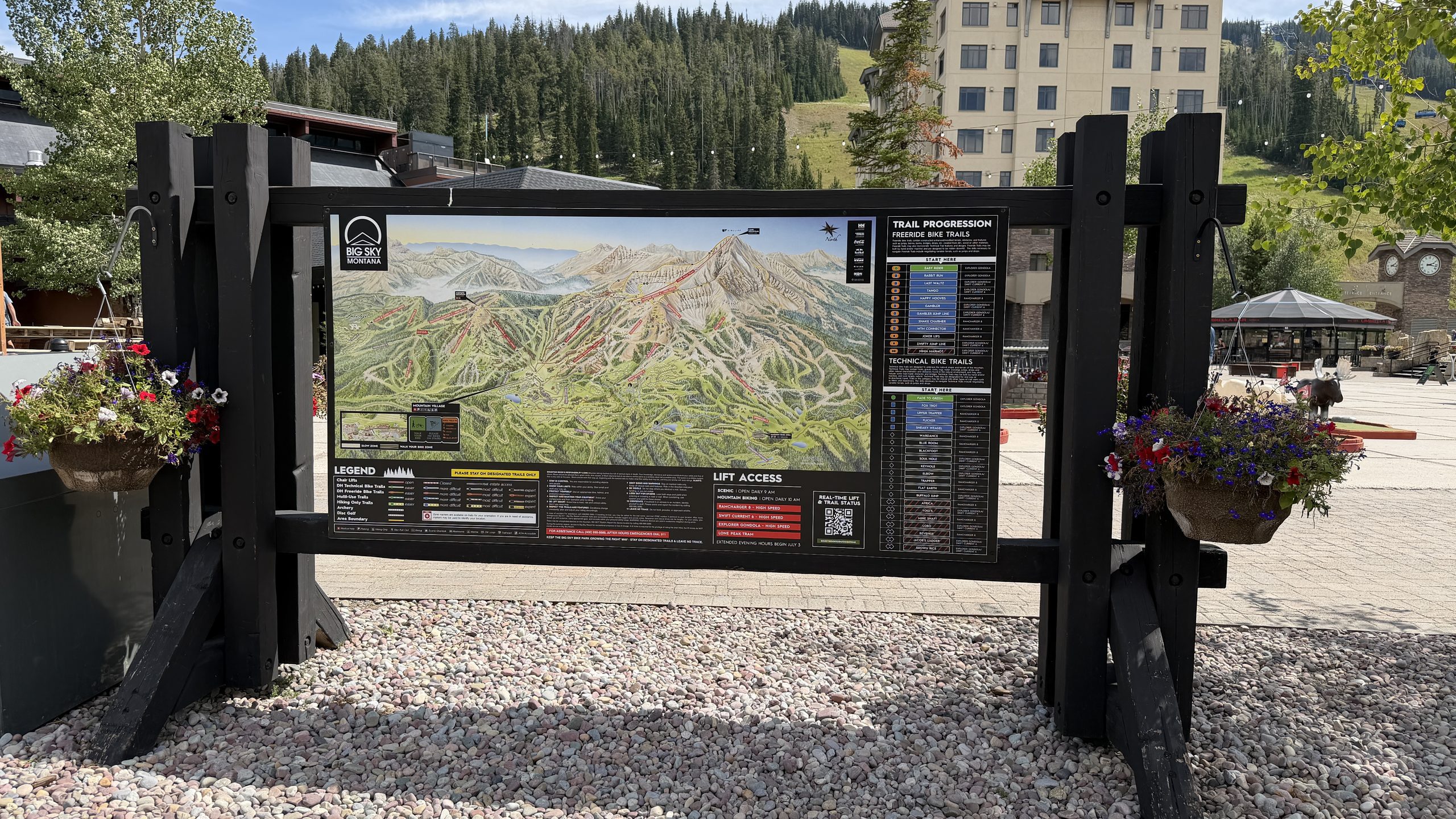
Big Sky has more than 50 miles of mountain bike trails and the area’s only lift-served riding, and the gondola now hauls bikes as well as people — new for this summer, since the Explorer Gondola itself isn’t yet a year old.
Munley walked me through how it works, and the system is more clever than I expected:
“There are eight spots and it rotates. So everyone lines up on a number at the bottom of the gondola. They wait for it to get to them. They attach their bike onto the bike gondola. Then, when they get to the top, they stand on that same number and their bike faces them. And they take it off.”
Bike hauling runs 10 a.m. to 5 p.m. daily, with bikes also permitted on Ramcharger 8 daily and Swift Current 6 on Fridays through Sundays.
If you ride at a level I frankly do not, Dirt Days runs every Friday from early July into September — a downhill race series for advanced and expert riders. Munley, who learned to ride in New Hampshire while working for the Appalachian Mountain Club and doing search and rescue, was refreshingly honest about the difference:
“The Northeast is kind of rocky, and it’s more cross-country mountain biking. But over here, I can do a green trail and that’s it. It’s really scary.”
If the resort’s PR manager, who has actual mountain-rescue credentials, is telling you the greens are plenty — believe her, and rent accordingly.
5. Meet The Neighbors
Two animals define this valley, and summer changes your odds on both.
Mountain goats live on Lone Mountain year-round, and as Munley explained, they’re far easier to pick out in summer, when white coats stand against bare rock instead of vanishing into snowpack. Keep 50 yards.
Bighorn sheep belong to the local Spanish Peaks herd, roughly 140 to 150 animals ranging from Durnham Meadows to Beartrap Canyon. Rams carry horn sets weighing up to 30 pounds. You’ll most often see them along US-191 in Gallatin Canyon, and near the Big Sky entrance on Highway 64, where they come down to lick salt off the road.
Statewide, Montana counts about 45 bighorn populations totaling roughly 5,700 sheep, not counting Yellowstone and Glacier. In the November rut, rival rams charge each other at around 20 miles an hour — which is not a summer sight, but it’s worth knowing what those horns are for.
And yes: carry bear spray. Visit Big Sky rents it at 88 Ousel Falls Road if you’d rather not fly with it.

6. Come Down The Mountain For The Town

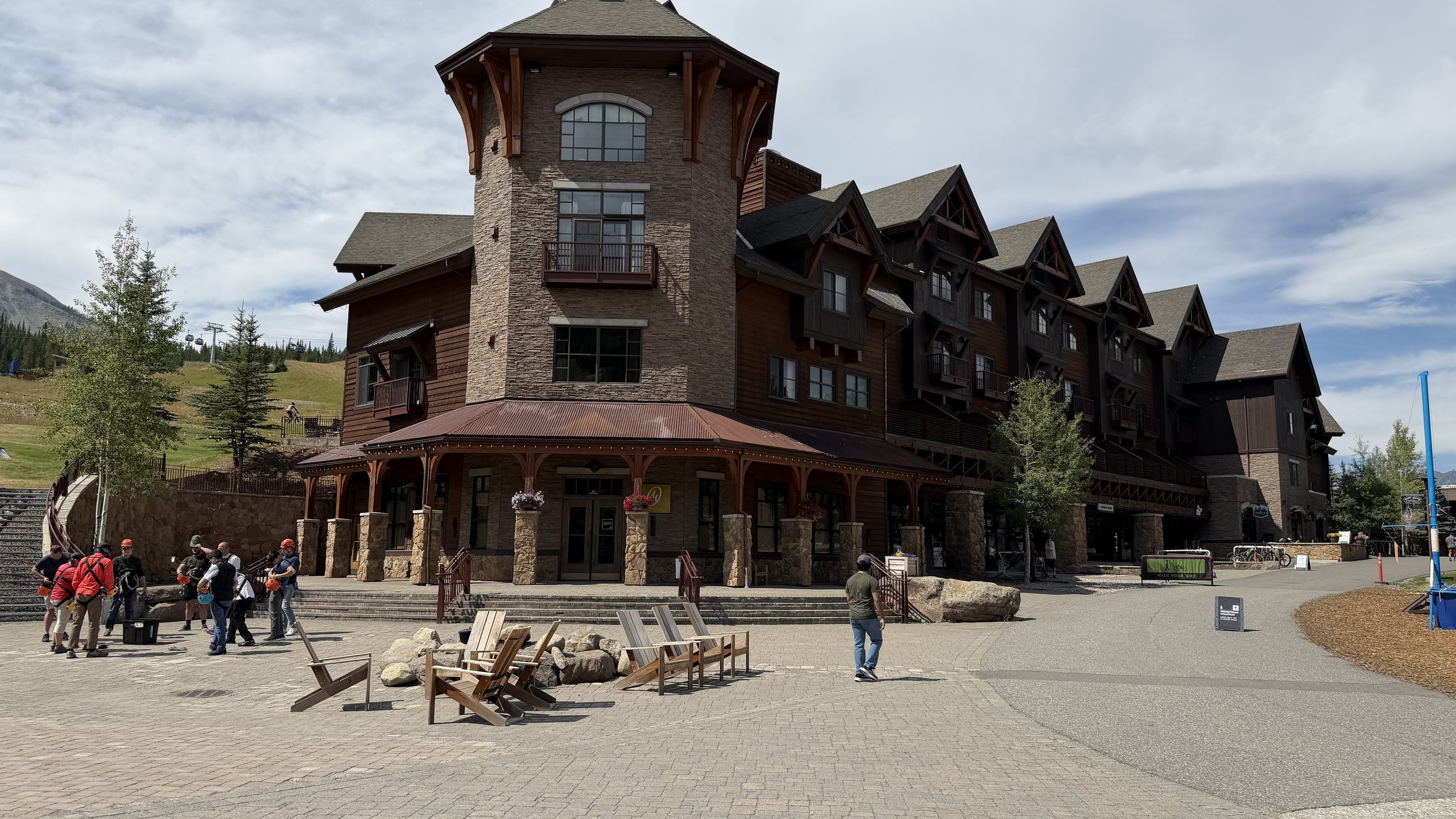
Nearby, Big Sky Town Center serves as the summer social, dining and shopping hub.
“The resort is a little bit on the quieter side,” Munley said, “but there’s a lot of opportunity there for us. And then the town is where everything comes alive.”
She’s right, and the weekly rhythm is the reason to structure a summer trip around midweek rather than a weekend:
Wednesdays — the Big Sky Farmers Market, 5 to 8 p.m. at Fire Pit Park, with more than a hundred vendors.
Thursdays — Music in the Mountains, a free concert series at Len Hill Park put on by the Arts Council of Big Sky, running late June through early September. Gates around 6, headliner at 8. “It’s a huge community-building time,” Munley said, and the price of admission is nothing.
Fridays — Dirt Days at the resort.
And in September — The Rut, which deserves its own paragraph. It’s a mountain running festival whose courses summit Lone Peak, with distances from an 11K up to a 50K, a brutal Vertical K that goes essentially straight up, and a Trifecta totaling 52.5 miles across the weekend. In 2026 it runs September 10 through 13.
“So you go to the top of Lone Peak, and you race,” Munley said. “It’s not for the faint of heart.”
Her friend is running it this year. I will be watching from the tram.
The Yellowstone Question

Big Sky sits about 50 miles from Yellowstone’s West Entrance — roughly an hour’s drive down the canyon through West Yellowstone. The park drew nearly 4.8 million visits in 2025.
And here is the opportunity, stated plainly by the resort itself. I asked Munley whether people base themselves in Big Sky to explore Yellowstone.
“I think some do. I don’t think that’s the norm right now. I think Big Sky is still seen overall as a winter destination for most people. So one of the things we’re trying to do is to promote Big Sky as a place that you can explore in the summer as well.”
That gap is your advantage. Big Sky is close enough to make Yellowstone a comfortable day trip, and it is not yet where most park visitors think to sleep. You get a real mountain town with restaurants, breweries, live music and a farmers market, an hour from the West Entrance, without the gateway-town scramble.
Munley also gets the Yellowstone question in another form entirely — the television one. Montana is having a cultural moment, and she’s watched it land overseas.
“We go to Australia every year, and I meet with journalists there, and they’re like, have you seen Yellowstone? And I hate to say, I’ve never seen a single episode. I’m like — why watch Yellowstone when I have Yellowstone right here?”
Best line of my trip.
Four Seasons In One Day

Everyone in this valley says it, and after four days I can confirm it is not marketing copy.
You wake up and it’s cold — that’s fall. The sun comes up and it’s spring. Midday is summer. And by evening it’s winter again. I said as much to Munley, half expecting her to laugh it off.
“Yes. Literally,” she said.
Pack for all four. A layer you can shed, a layer you can add, and shoes that are not Crocs, whatever those football players managed.
Plan Your Trip
- Summer season: The resort’s summer operations run mid-June to mid-September — in 2026, June 13 through September 13. Big Sky Resort closes twice a year, roughly late April to mid-June and mid-September to mid-November, reopening for ski season the day before Thanksgiving.
- Getting there: Fly into Bozeman Yellowstone International Airport (BZN), about 45 miles and an hour north. Rent a car.
- Kircliff and scenic lifts: Daily 9 a.m. to 4:30 p.m., with extended sunset hours Friday through Sunday. Tickets start at $45 and cover all-day access to the Explorer Gondola, Lone Peak Tram and Ramcharger 8; children 6 and under ride free. There’s no food, water or restroom at the summit, and it is cold up there in August — bring a layer.
- The resort itself: 5,850 acres, more than 300 named runs and 40 lifts across the winter footprint; 50-plus miles of summer bike trails.
- Scale of the town: Big Sky’s year-round population is around 3,500. Bozeman, an hour north, runs about 60,000.
- Hike smart: Start early at Beehive Basin, carry bear spray, keep 50 yards from goats and sheep, and expect weather.
- Worth knowing: In October 2025, Montana DEQ approved Big Sky’s reclaimed-water snowmaking program — making it the first public ski area in the state permitted to make snow from reclaimed water, for base-layer coverage on Spirit Mountain, Andesite Mountain and the Spanish Peaks base area.
Frequently Asked Questions

Is Big Sky Resort open in the summer?
Yes. Summer operations run mid-June through mid-September — June 13 to September 13 in 2026 — with scenic lift rides, the Kircliff observatory, lift-served mountain biking, hiking, golf and zip lining. The resort closes between seasons: roughly late April to mid-June, and mid-September to mid-November.
Is Big Sky worth visiting in summer?
Yes, and for many travelers it’s the better season. Lodging costs less than in ski season, the range of activities is far wider than skiing and snowboarding, and there’s none of the winter friction around driving conditions and road closures. As the resort’s PR manager puts it, summer is the more accessible season for people easing into the outdoors.
What is Kircliff at Big Sky Resort?
A two-story glass observatory at 11,166 feet on the summit of Lone Peak — the highest scenic overlook in Montana. It opened December 20, 2025, alongside the Explorer Gondola, and has a glass floor and views of ten-plus mountain ranges, three states and Yellowstone on the southern horizon. Reachable by gondola and tram in about 15 minutes, with no hiking or skiing required.
Is the Lone Peak summit wheelchair accessible?
In summer, yes. A 517-foot paved path with a maximum grade under 5 percent connects the Explorer Gondola’s upper terminal to the lower tram terminal, and both the tram and Kircliff are accessible. In winter the path is snow-covered and not wheelchair-suitable.
What is the best wildflower hike in Big Sky, Montana?
Beehive Basin — about 6.6 to 7.2 miles round trip with roughly 1,600 to 1,700 feet of gain, ending at an alpine lake. Bloom runs late June through August, with Indian paintbrush later in the season. Go early or on a weekday; it gets busy.
Can you mountain bike at Big Sky Resort in summer?
Yes. The resort has more than 50 miles of trails and the area’s only lift-served riding. The Explorer Gondola hauls bikes from 10 a.m. to 5 p.m. daily using a rotating, numbered loading system; bikes also ride Ramcharger 8 daily and Swift Current 6 Friday through Sunday. Dirt Days, a downhill race series for advanced and expert riders, runs Fridays from early July into September.
How far is Big Sky from Yellowstone National Park?
About 50 miles south on U.S. 191 to the West Entrance at West Yellowstone — roughly an hour. Big Sky is one of the closest full-service basecamps to that gate, and far less crowded than the gateway towns.
What is The Rut at Big Sky?
A mountain running festival held each September whose courses summit Lone Peak. Distances range from an 11K to a 50K, plus a Vertical K that climbs straight up and a Trifecta totaling 52.5 miles across the weekend. In 2026 it runs September 10–13.
What should I pack for Big Sky in summer?
Layers, and more than you think. Locals describe getting all four seasons in a single day — cold mornings, warm midday, cold evenings — and it snowed a foot on Lone Peak two days before July in 2026. Bring bear spray for hiking, or rent it in town.
Also Read:
7 Best Places in Northern Italy To Visit
The Design Lover’s Guide to Houston: Art, Food, Shopping & Creative Stays
8 Unique Iceland Bucket List Destinations: Explore Off-the-Beaten-Path Locations