




This post contains affiliate links. If you buy through them, I may earn a small commission at no extra cost to you. I only recommend gear I actually use and love. See my full disclosure here.
A sea-level girl’s guide to the geysers, the bison jams and the 8,000-foot day that rearranged what I thought I knew about national parks.

I grew up in a state whose average elevation is about 100 feet above sea level. Louisiana is a place where “the high ground” means the levee. So when my guide mentioned, somewhere between the second geyser basin and the third bison jam, that we were standing at roughly 8,000 feet, I did the only sensible thing and sat down on a boardwalk bench to think about it.
That is the first thing nobody tells you about Yellowstone. It is not a park you walk into. It is a plateau you climb onto, and your lungs could file a complaint.
The second thing nobody tells you is how much of it you will not see. I booked a full-day Lower Loop tour out of West Yellowstone, Montana — eight hours, a comfortable van, a guide who had been doing this for years — and at the end of a very long day, my guide Gypsy did the arithmetic out loud: we had covered around 150 miles of park road and seen, by his estimate, about a quarter of one percent of Yellowstone.
I have thought about that number more than any photograph I took.
Why Tour the Lower Loop — and Why Let Someone Else Drive

Yellowstone’s road system is a figure eight. The Grand Loop is roughly 142 miles total; the Lower Loop is the southern half of it, and it is where the park keeps its greatest hits — Old Faithful, the Grand Prismatic Spring, Hayden Valley, Yellowstone Lake and the Grand Canyon of the Yellowstone. If you have one day, this is the day.
I departed from West Yellowstone, Montana, which sits at the park’s West Entrance and is the most practical basecamp on the Montana side. My tour was with Yellowstone Vacation Tours, whose office is at 415 Yellowstone Avenue, and I want to make an argument for the guided option even if you are the kind of traveler who normally refuses one. I am that kind of traveler. I was wrong.
Here is what a guide buys you. The roads through Yellowstone are narrow, mostly single-lane in each direction, with no shoulder to speak of. Every wildlife sighting becomes a traffic event. You will spend a meaningful percentage of your day stopped, and if you are the one driving, you will spend that percentage looking at the bumper in front of you instead of at the animal.
More than that: all day long, Gypsy was on the radio with other guides in the park, trading intelligence. Where the bison herd had moved. Which geyser was building. Which pullout had already collapsed into chaos. He rerouted us three or four times based on information no app was going to give me. That is not a convenience. That is the difference between seeing the park and driving through it.
Get In Early. Seriously.

We arrived at the West Entrance right at opening, ahead of the line of cars that starts stacking up on the main road within the hour. This is the single highest-leverage decision of the day.
It also gave me my favorite line of the trip. As we crept past our first cluster of tourists who had abandoned their cars mid-road to sprint toward a bison with their phones out, Gypsy said, cheerfully, over the microphone:
“I promise at the end of the day you won’t be proud of your species.”
Reader, he was right by 10 a.m.
A Word About the Wildlife, Because People Keep Getting Hurt
I am going to be direct here, because the friendly version of this warning clearly is not working.
Yellowstone is home to nearly 5,300 bison. A bull can weigh 2,000 pounds. They are not livestock; they are not props, and they can outrun you without trying.

On July 10, 2026, a 65-year-old man walking with his grandson near Bridge Bay Campground on Yellowstone Lake was charged by an agitated bull during the rut. It caught him with a horn near the hip and threw him roughly eight feet into the air. He needed surgery. By witness accounts, the man had done nothing wrong — he was well beyond the required distance, and the animal had already charged people at a neighboring campsite. That is the part worth sitting with. Even doing everything right doesn’t guarantee safety during rutting season.
The park’s own record is sobering. Since 1872, according to the U.S. Geological Survey’s Yellowstone Volcano Observatory and park historian Lee Whittlesey’s Death in Yellowstone, drowning has been the leading cause of unnatural death in the park, with more than 120 fatalities. Eight people have been killed by bears. Twenty-two have died of burns after falling into thermal features.
Whittlesey’s book is sold in the gift shops. It is not a novelty item. It is a manual on humility.
Gypsy told us that a bison he and the other guides call Henry has tossed a visitor in each of the last four seasons. I have no way to verify that, and I pass it along as guide lore rather than fact. But I noticed that nobody in our van laughed.
Stay in the vehicle when your guide says to. Keep 25 yards from bison and elk, 100 yards from bears and wolves. Do not get the shot.
What You’re Actually Standing On
Here is the thing I did not fully appreciate until I was on it: Yellowstone is a volcano. Not near one. On one.
It is one of the largest active volcanic systems on Earth — a supervolcano whose last caldera-forming eruption, 631,000 years ago, collapsed the center of the landscape into a basin roughly 30 by 45 miles across. That basin is the park. The heat still rising from the magma reservoir beneath it — which the National Park Service places about three to eight miles down beneath Sour Creek Dome — is what powers every geyser, hot spring, fumarole and mud pot you will see all day. The park logs somewhere between 1,500 and 2,500 small earthquakes a year. You will feel none of them and you should think about all of them.

That volcanic ground grows a specific kind of forest. Lodgepole pine covers about 80 percent of Yellowstone’s forest canopy — tall, slender trunks, needles in bundles of two, the only pine in the park you can identify that way. Some lodgepoles produce serotinous cones sealed with resin that only opens in the heat of a wildfire. The tree does not merely survive fire. It requires it.
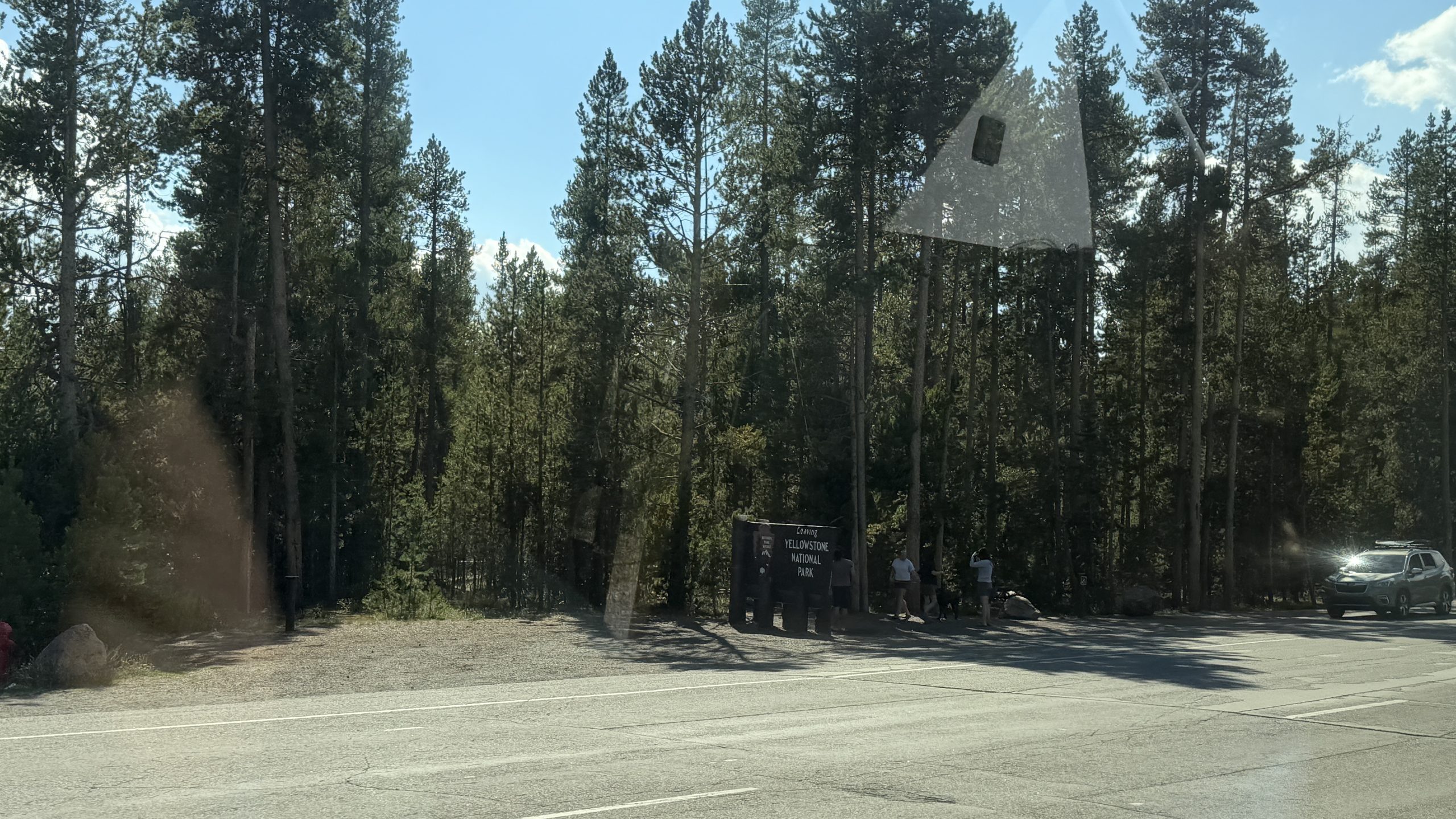
Which explains the trees you will see. In 1988, fire affected about 36 percent of the park — nearly 794,000 acres. The lodgepoles that came back are the 25- to 30-foot ones lining the road today. An entire forest, the same age, because of a single summer.
That fire has a good story, too. Idaho farmers, mobilized by church leaders, trucked in twelve semi-loads of irrigation pipe and ringed the town of West Yellowstone with agricultural sprinklers, running them around the clock, unpaid. They also protected the generator pumping water for Old Faithful Lodge. Potato irrigation equipment is a large part of why the town I departed from that morning still exists.
The Thermal Features: Reading the Colors

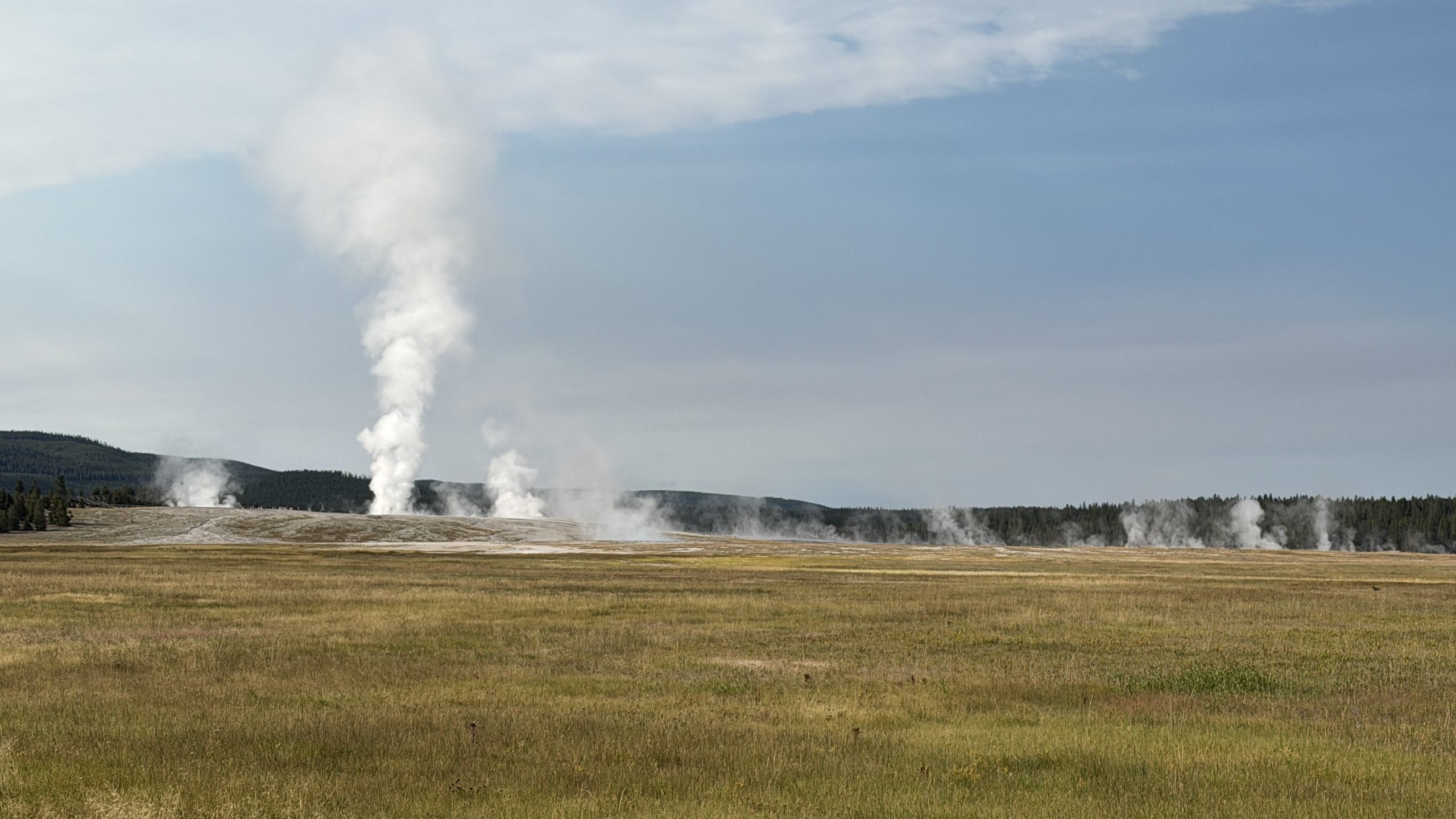
More than 10,000 thermal features are concentrated in this park. That is what makes Yellowstone Yellowstone.
You smell them before you see them — the rotten-egg sulfur that hangs over every basin. Then you come around a boardwalk corner and the ground is turquoise, ochre, rust and jade, and it looks like someone spilled paint.
It is not paint. It is alive.

Those colors are thermophiles — heat-loving microorganisms, each species thriving in its own narrow band of water temperature. The color tells you the temperature. You are looking at a heat map drawn by bacteria. The blues in the deeper pools come from silica in the water and the way it scatters light.
And here is my favorite fact in the entire park, which I want to state carefully because it gets garbled constantly: in 1966, a bacterium called Thermus aquaticus was isolated from a hot spring in Yellowstone’s Lower Geyser Basin. It yielded a heat-stable enzyme called Taq polymerase — the thing that makes PCR possible. PCR is the technology behind modern DNA testing, including COVID tests, and it earned a Nobel Prize in 1993.
Not the vaccine. The test. But still: the reason a swab could tell you whether you were sick started in a puddle in Wyoming.
The Basins Worth Your Time

Black Sand Basin takes its name from sand made of black volcanic glass — obsidian — and the boardwalk loop is short. Watch for Cliff Geyser, which erupts every few minutes, sometimes to 40 feet. There are a few steep sections, so it’s manageable with assistance rather than fully barrier-free.
Upper Geyser Basin is the headliner. One square mile holds at least 150 hydrothermal features, making it the most densely concentrated geyser field in the world.
Midway Geyser Basin holds Grand Prismatic Spring, Yellowstone’s largest hot spring and the third largest on Earth. It also holds Excelsior, which in the 1880s erupted 100 to 300 feet and was reckoned among the largest geysers anywhere. It is dormant now — a vast steaming crater dumping thousands of gallons a minute into the Firehole River.
Norris Geyser Basin is the park’s hottest, oldest and most dynamic thermal area, and home to Steamboat, the tallest active geyser in the world at 300 to 400 feet. It erupts on no schedule anyone can predict. Standing there feels like waiting outside a door.
Sulphur Caldron is the one that stops conversation. Its pH runs between 1 and 2 — the Park Service compares it to car battery acid — and it is a churning, mustard-colored, profoundly foul-smelling pool. And it is full of life. Microorganisms are thriving in something that would strip paint.
Old Faithful: How to Actually Catch It

This was the moment I came for, and I nearly mistimed it.
Old Faithful is not on a clock. It is predictable, which is different — the Park Service posts a predicted window with a margin of about ten minutes on either side, and current intervals run roughly 94 minutes or 68 minutes depending on the length of the previous eruption. When it goes, it sends water 106 to 184 feet up.

The practical tip: the visitor center and the gift shop both post the next predicted eruption. Check it the moment you arrive in the Old Faithful area, then plan the rest of your time in the Upper Geyser Basin around it rather than sitting on the bench for an hour. For the other geysers, download GeyserTimes, which tracks predicted eruption windows and eruption history across the park.
Build your day around the prediction. Do not build your day around the bench.
Hayden Valley, the Canyon and the Falls
Hayden Valley is the park’s great open room and its best wildlife theater. I visited in late August, during the bison rut, and the herds were everywhere — bulls bellowing across the sage, tree trunks shredded where they had rubbed off the last of their winter coats. I did not see a bear, a red fox or a wolf. Gypsy explained that summer bears are up high in the mountains working the berry crop.
Huckleberries, mostly. Tangy, sweet, ubiquitous in late summer, beloved by wildlife and by every bakery in a hundred-mile radius.
Berries are also why I spent an embarrassing amount of the afternoon looking for drunk birds. Cedar waxwings gorge on overripe fruit whose sugars have fermented into alcohol, and they genuinely do become intoxicated — disoriented, uncoordinated, prone to flying into things. It is well documented and occasionally fatal for the bird. Look for a pale yellow belly and white undertail coverts at lower elevations near berry-producing shrubs. Birders: get the Merlin app from the Cornell Lab. Photograph, upload, identified.
Then the canyon.

The Grand Canyon of the Yellowstone runs about 20 miles long and more than 1,000 feet deep, its walls banded in yellows, oranges and pinks from hydrothermally altered rock. The Lower Falls drops 308 feet — nearly twice the height of Niagara — and it is the single most arresting thing in a park that is composed almost entirely of arresting things. The park has close to 300 known waterfalls. This is the one.
The classic view is from Artist Point on the south rim. You can also take it in from Lookout Point, Red Rock Point and the Brink of the Lower Falls Trail.

A correction worth making, because I had it wrong myself: Artist Point is popularly said to be named for Thomas Moran, the painter who traveled with the 1871 Hayden Survey and whose canvases helped convince Congress to protect this place — it bought The Grand Canyon of the Yellowstone for $10,000 in 1872. But Moran sketched from the north rim, at the overlook the survey named Moran Point. The photographer F. Jay Haynes appears to have misattributed the south-rim viewpoint in an 1890 guidebook, and the name stuck. The art history is real. The naming is a 135-year-old clerical error.

Yellowstone Lake and the Long History

Yellowstone Lake is the largest high-elevation lake — above 7,000 feet — in North America, sitting at 7,733 feet. Mud pots, hot springs and geysers discharge directly into it. Mud pots are genuinely rare worldwide, and unpleasant up close in a way I found delightful.

Lake Village has the best lake views and a general store beside the historic Lake Hotel, which the Park Service calls the oldest operating hotel in the park. It opened in 1891; architect Robert Reamer gave it its columns in 1903.
The travel history here is worth a minute. From 1891, visitors rode a stagecoach from the Old Faithful area to West Thumb, then boarded a steamboat called the Zillah for the roughly 15-mile crossing to the Lake Hotel. The Zillah was replaced around 1910. The first automobile was admitted on August 1, 1915, and by 1917 horse-drawn vehicles were prohibited entirely — the park went from stagecoach to motorcar in two years.
Longer than any of that: people have been in this region for more than 11,000 years. Twenty-seven tribes are associated with Yellowstone and hunted here seasonally. The Tukudika, or Sheep Eaters, moved seasonally by elevation; the Shoshone-Bannock tribes of southeastern Idaho hold that some Tukudika remained in the park year-round.
Yellowstone was set aside on March 1, 1872, as the world’s first national park — protected, notably, not for its wildlife but for its hydrothermal features.
The Madison River, and Why Everyone Here Fly Fishes

We passed the Madison River on the way out, dark and slow and steaming faintly in the cold.
The Madison forms where the Firehole and Gibbon rivers meet, and both of those are thermally influenced by the geyser basins upstream — which is why the upper Madison runs warmer than it has any right to and stays partly open through winter. That is why the elk, bison and trumpeter swans stack up along it in January.
It is also, right now, a television location. The Madison, Taylor Sheridan’s series starring Michelle Pfeiffer and Kurt Russell, follows a New York family rebuilding in Montana’s Madison River Valley; it premiered on Paramount+ in March 2026. Fair warning to location pilgrims: much of the Montana material was actually shot around Three Forks, Ennis and Gallatin Canyon, with a significant portion filmed in Texas.

The fly fishing, though, is not a set. The Gibbon and the Madison are legitimately among the best trout water in the world, and the Big Sky region just north sits among the finest cold-water rivers in the country — the Gallatin, the Madison, the Yellowstone. Snowmelt keeps them cold and oxygen-rich. A River Runs Through It filmed some of its fishing scenes on the Gallatin, which did the region’s mythology no harm.
What struck me, watching anglers work the seams, was how little of it is about the fish. Fly fishing here is a way of reading water — noticing temperature, light, insect hatches, current, the specific soft spot behind a rock where a trout might be holding. It is close attention, formalized. Which, come to think of it, describes the whole park.
Good to Know Before You Go
- Book a guided tour if you can. The radio network between guides is worth the ticket by itself.
- Enter at opening. Traffic compounds all day.
- Bring layers. I was there in late August and wanted a jacket in the morning. Winter buries these roads under about four feet of snow.
- Photo ID is required for everyone 16 and older entering with a tour.
- The best route to Grand Teton is south through West Yellowstone.
- Download two apps: GeyserTimes for eruptions, Merlin for birds.
- Ask about the citizen scientist programs. Visitors help rangers with real data collection, including trumpeter swan migration studies.
- Federal law supersedes state law inside park boundaries.
- For researchers: the Heritage and Research Center is a working library in the park, holding collections that include stagecoach-era journals.
Frequently Asked Questions
How long does it take to tour Yellowstone’s Lower Loop?
Plan a full day — roughly eight to ten hours from West Yellowstone, including the drive in and out. Guided tours typically check in around 8 a.m. and return in the early evening.
What is the difference between Yellowstone’s Upper and Lower Loop?
Yellowstone’s road system is a figure eight totaling about 142 miles. The Lower Loop is the southern half and includes Old Faithful, Grand Prismatic, Hayden Valley, Yellowstone Lake and the Grand Canyon of the Yellowstone. The Upper Loop covers Mammoth Hot Springs, Tower and the park’s northern range.
Can you tour Yellowstone from Montana?
Yes. West Yellowstone, Montana sits at the park’s West Entrance and is the most convenient Montana basecamp, with multiple tour operators running daily Lower Loop trips. Big Sky is about an hour north, and Bozeman roughly two.
Is a guided Yellowstone tour worth it?
In my experience, yes — mostly because guides share real-time conditions with each other by radio and reroute around traffic and toward active wildlife and geysers. You also get to look out the window instead of at the road.
When does Old Faithful erupt?
Intervals currently run about 94 minutes or 68 minutes, depending on the length of the previous eruption, and eruptions reach 106 to 184 feet. The Park Service posts predicted times at the visitor center with a window of about ten minutes either side.
What is the best time of year to tour Yellowstone’s Lower Loop?
Late spring through early fall, when the loop roads are open. Late August brings bison rut and huckleberry season. Most park roads close to regular vehicles in winter, when snow can reach four feet on the roadway.
How close can you get to bison in Yellowstone?
Stay at least 25 yards from bison and elk and 100 yards from bears and wolves. Bison injure visitors nearly every year, including a 65-year-old man gored near Bridge Bay Campground in July 2026 who was reportedly well beyond the required distance.
Also Read:
Why You Should Visit Big Sky Resort in Summer: Six Ways to Encounter the Montana Landscape
Luxury Coolcation: 3 Cool-Weather Homes to Beat the Summer Heat
First Look: Inside One&Only Moonlight Basin, Big Sky’s New Ultra-Luxury Alpine Resort